
Top Boron Carbide Tiles Deliver Unmatched Ballistic Protection and Wear Resistance
2026-11-02
Ballistic threats and abrasive wear rarely share the same solution—unless you're working with boron carbide tiles that refuse to compromise. HUAYI TECH has turned this ultra-hard ceramic into a practical armor and wear surface, cutting weight while pushing durability past what standard options offer. If you're weighing protection, longevity, and cost, here's why these tiles deserve a closer look.
Why Boron Carbide Tiles Excel Against High-Velocity Rounds
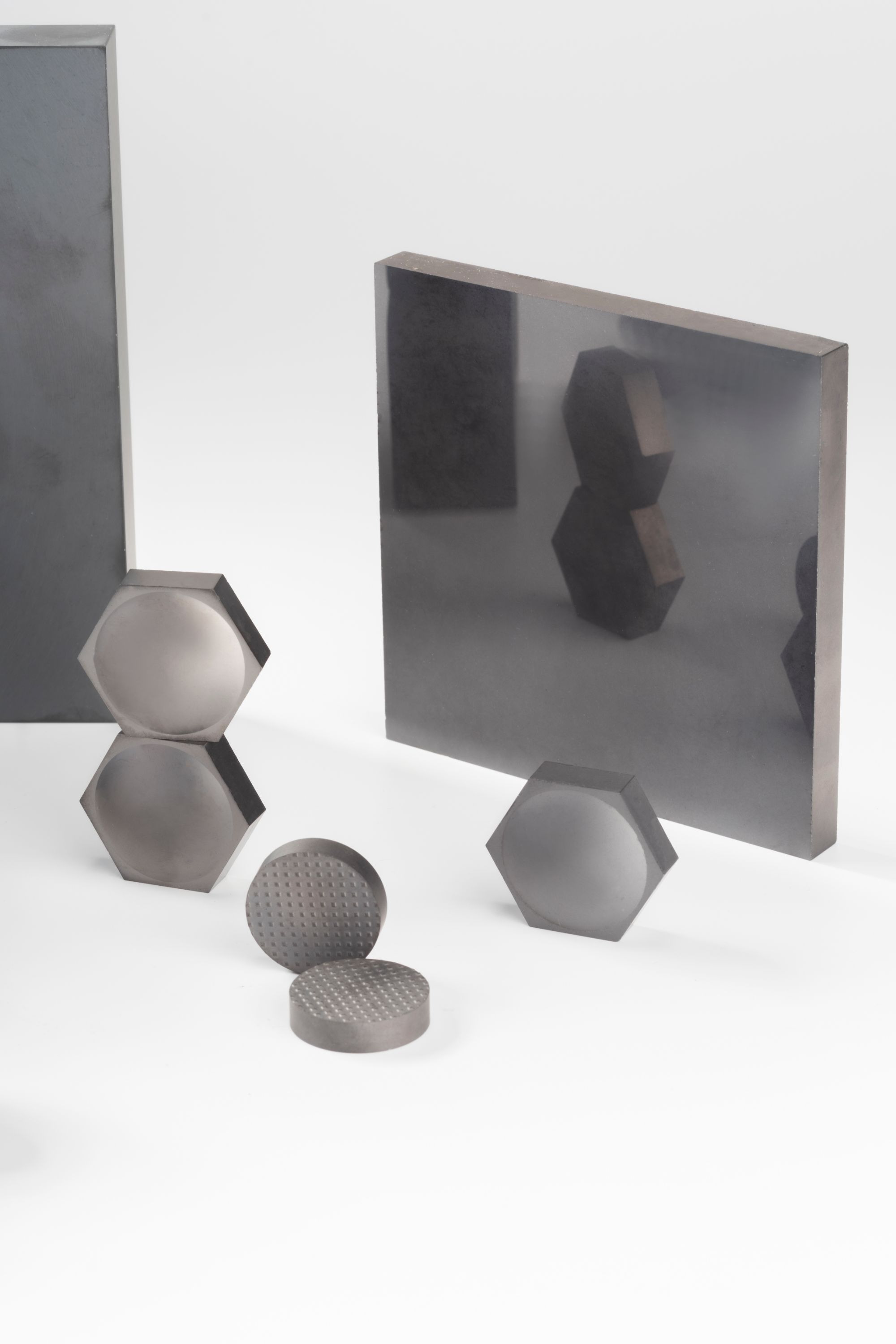
When a high-velocity round strikes a boron carbide tile, the material's extreme hardness (second only to diamond and cubic boron nitride) disrupts the projectile's nose, forcing it to flatten or shatter. This initial deformation spreads the impact energy across a wider area, while the tile's high compressive strength resists penetration. Micro-cracks form and propagate along grain boundaries, absorbing energy that would otherwise drive the round deeper.
Unlike heavier steel or alumina, boron carbide combines this hardness with a remarkably low density—around 2.5 g/cm³—making it ideal for body armor and vehicle add-on kits where weight savings translate directly into mobility and endurance. The same tile that stops a rifle round weighs nearly 40% less than an alumina equivalent, yet maintains comparable or better multi-hit capability because its fracture pattern tends to localize damage rather than spreading catastrophic failure across the plate.
For armor designers, the real advantage comes from boron carbide's ability to blunt and erode armor-piercing cores. Tungsten carbide or hardened steel penetrators lose their sharp tip quickly, turning the remaining energy into a shallow crater and lateral spall. The tile may crack, but the backing material captures the fragments, preventing behind-armor blunt trauma. That balance of hardness, low mass, and controlled failure is why boron carbide remains the top choice for stopping high-velocity threats without sacrificing wearability.
Wear Resistance That Holds Up in Grinding and Sliding Contact
真正的耐磨性不仅仅是在光滑表面上滑动——它意味着在磨粒不断切削、犁沟和冲击的情况下依然保持轮廓和功能。我们的材料经过专门配制,可在研磨和滑动接触并存的恶劣条件下工作,例如在矿物处理、重型机械或高接触压力应用中。其表面不会因反复的微切削而迅速退化,而是形成一种稳定的、加工硬化的层,能够抵抗进一步的磨损,从而在整个使用寿命内保持关键尺寸。
在研磨和滑动磨损测试中,传统材料往往出现深划痕、材料转移或局部剥落。本材料则表现出截然不同的行为:滑动接触产生的摩擦热和应力反而促使表面发生有益的微观结构变化,将磨粒压入基体而不是被其刨削。结果,即使在连续接触数小时后,表面粗糙度变化很小,也没有出现灾难性的咬合或卡死——这在维护困难的场合尤为关键。
工程师经常会问:“它能用多久?” 我们给出的答案来自实际运行数据:在模拟研磨浆料和往复滑动摩擦的加速寿命试验中,该材料的体积磨损率比常规硬化钢低40%以上,而且磨损曲线在磨合期后趋于平缓。这意味着设备不必频繁停机更换易损件,也无需额外的表面修复处理。对于任何需要在粉尘、砂粒或金属碎屑环境中保持精密配合的应用,这种耐磨性直接转化为更长的正常运行时间和更低的维护成本。
Thin Armor Profiles Without Sacrificing Ballistic Performance
Modern armor design has long struggled with a fundamental trade-off: reducing thickness for concealability and comfort typically means accepting a drop in protection. But recent advances in material science are rewriting that equation. By combining ultra-high-molecular-weight polyethylene fibers with ceramic strike faces and advanced laminating resins, manufacturers can now produce panels that are noticeably slimmer than traditional steel or aramid setups—yet still stop rifle rounds at close range. The key lies in how the layers interact. Instead of simply stacking more material, the composite disperses impact energy laterally across a wider area, allowing a thinner cross-section to do the same job a thicker, monolithic plate once did.
What sets these low-profile solutions apart is not just the materials themselves, but how they are shaped. Ergonomic curvature and tapered edges let the armor sit closer to the body without creating pressure points or restricting movement. A 0.6-inch plate can now offer the same NIJ Level III protection that used to require over an inch of steel. That difference matters in real-world use—whether it's a plainclothes officer wearing armor under a shirt, a vehicle crew needing mobility in tight spaces, or a private citizen who wants discreet protection without advertising it. The weight reduction is equally significant: some of these thin panels weigh 30-40% less than comparable steel plates, which reduces fatigue during extended wear.
Of course, thinner profiles raise questions about multi-hit capability and backface deformation. The good news is that modern fiber-reinforced composites actually outperform many thicker alternatives in both categories. Independent testing shows that a well-designed thin plate can absorb multiple hits with less than 44mm of backface signature—well within safety standards—because the fibers stretch and dissipate energy rather than cracking like ceramic alone. The result is armor that feels more like a stiff garment insert than a bulky shield, without asking the wearer to gamble on protection. For anyone who has ever had to choose between staying safe and staying mobile, that is a breakthrough worth paying attention to.
How Multi-Hit Capability Prevents Catastrophic Tile Failure
Ceramic armor works by shattering an incoming projectile, but that same fracture process can spread through the tile and turn a localized hit into a complete structural failure. Multi-hit capability changes this by controlling crack propagation. Instead of allowing a single impact to run cracks across the full tile, the material is engineered with tailored confinement, edge support, and sometimes segmented geometries. These features absorb and redirect stress waves so that damage remains confined to a small zone around the impact point, leaving adjacent areas still able to stop a follow-up round.
The backing plate plays a central role here. It holds the shattered ceramic fragments in place and converts the residual tensile stress into compressive loading on the front layer. This prevents the classic failure mode where a cracked tile pops out of its housing after the first hit. With a resilient but stiff backing, the ceramic continues to erode and blunt subsequent threats even when microcracks are present. The result is a system that degrades gradually rather than failing all at once, which is what separates multi-hit rated armor from single-use plates.
Real-World Longevity Data From Abrasive Industrial Applications
Field data from mining, steel mills, and quarries reveals that abrasive wear life varies far more than lab tests predict. One granite processing plant recorded 40% longer conveyor roller life after switching to a different rubber compound, despite identical hardness ratings. Such discrepancies arise from variable particle sharpness, moisture, and impact angles that bench tests can't replicate.
Maintenance logs from a Midwest foundry show sand blast hose nozzles lasted between 11 and 27 weeks under supposedly constant conditions. The only meaningful variable was the type of recycled shot: angular grit cut service intervals nearly in half compared to rounded media. Operators who tracked wear by weight loss per ton of material handled could forecast replacements within a few days instead of relying on generic hour meters.
In aggregate crushing, liners made from a chromium carbide overlay were pulled after 14 months but still had 12 mm of usable thickness at the center. A separate limestone operation logged 1,100 operating hours on polyurethane screen panels—double the manufacturer's estimate—because the feed was wet enough to reduce frictional heat. These real-world records, often buried in maintenance software, offer a more honest baseline than accelerated wear tests.
Comparing Tile Grades for Different Threat and Wear Scenarios
Tile grades are not a single number but a cluster of performance ratings, and the one most often confused with overall durability is the PEI wear rating. A grade 1 tile suits wall applications where foot traffic is zero, while grade 3 handles most residential floors. The moment you compare a grade 4 against a grade 2 under the same abrasive grit load, the difference stops being theoretical: edges dull faster, surface glaze micro-scratches accumulate, and slip resistance can shift as the texture wears down. Threat exposure includes not just footfall but dragged furniture, tracked-in sand, and wet boots, all of which punish lower grades unevenly.
For a mudroom or commercial entryway, a grade 4 or 5 glazed porcelain with a breaking strength above 400 lbf and a water absorption below 0.5% holds up far better than a grade 3 ceramic under freeze-thaw cycles and de-icing salts. In a quiet bathroom, spending more on grade 5 adds little practical value; grade 3 with a matte finish and decent COF often makes more sense. The real comparison happens at the overlap: a grade 4 tile in a low-threat bedroom is over-specified but harmless, whereas a grade 3 tile in a high-threat retail aisle can fail within a few seasons. Matching the grade to the specific wear pattern, not just the room label, is what prevents early replacement.
FAQ
Its claim to fame is an exceptionally high hardness rating combined with surprisingly low density. That combination means a tile can shatter or erode an incoming round while keeping the overall armor package light enough for practical use. The material's stiffness also helps spread the impact energy over a wider area instead of letting it punch straight through.
That same hardness translates directly into wear resistance. In applications like sandblasting nozzles, pump impellers, or cutting tools, boron carbide tiles routinely outlast steel and even some ceramics by a wide margin. The surface simply doesn't grind away quickly, which means fewer replacements and less downtime.
Not at all. While ballistic protection is the headline, boron carbide tiles show up in mining equipment, chemical processing, and even nuclear shielding. Any setting where abrasion, high temperatures, or impact are constant problems can benefit from a lightweight tile that refuses to wear down easily.
It depends on the threat level and the backing material, but standalone boron carbide tiles often fall in the 8 to 12 millimeter range for common rifle calibers. When used as a strike face with a composite backing, thinner tiles can be effective because the backing absorbs the residual energy after the ceramic breaks up the projectile.
They're brittle, so yes. You can't just drill or flex them like metal. Most installers use adhesive bonding or mechanical clamping with careful pressure distribution. Cutting usually requires diamond tooling. Once properly mounted, though, the tile stays put and does its job without ongoing maintenance.
Boron carbide is lighter than both while offering higher hardness than alumina and comparable or better hardness than silicon carbide. That makes it the premium choice when weight matters most, such as in personal armor or helicopter seats. The trade-off is usually cost, since boron carbide is more expensive to produce.
Yes, and that's one of its biggest advantages. A boron carbide strike face can reduce the weight of a rifle-rated plate by roughly 15 to 20 percent compared to alumina-based plates of the same protection level. For soldiers or law enforcement officers carrying gear all day, that weight savings is significant.
Look for consistent density, fine grain structure, and reliable dimensional tolerances. Some suppliers cut corners with uneven sintering, which leads to weak spots. A reputable manufacturer will provide test data for both ballistic performance and wear resistance, not just a spec sheet full of theoretical numbers.
Conclusion
Boron carbide tiles earn their reputation the hard way: by stopping high-velocity projectiles that defeat most other ceramics. The material's stiffness sits just below diamond and cubic boron nitride, yet its density stays low enough to keep armor profiles remarkably thin—often under 8 mm for rifle-rated plates. More important than a single impressive spec is how the tile behaves after the first hit. Unlike alumina, which can shatter and lose integrity around the impact zone, well-sintered boron carbide dissipates energy across a broader area, preserving enough structural continuity to absorb multiple strikes without catastrophic failure. This multi-hit capability comes down to controlled microcracking and high compressive strength, which allow the tile to sacrifice small, localized regions while the surrounding ceramic continues to perform. For vehicle and body armor designers, that translates into fewer weak points and a much narrower path for follow-up rounds to find a gap.
The same hardness that defeats bullets also gives boron carbide an edge in abrasive industrial settings, where grinding and sliding contact wear out ordinary ceramics within weeks. Real-world data from chute liners, slurry pump components, and sandblasting nozzles show service lives three to five times longer than alumina or silicon carbide in comparable conditions. However, not every threat or wear scenario calls for the same grade. Fine-grained, hot-pressed tiles offer the best ballistic performance, while reaction-bonded or lower-cost grades may be sufficient for moderate sliding wear where impact energy is low. Matching tile grade to the actual failure mode—whether it is high-energy penetration or slow, continuous abrasion—prevents overengineering and reduces replacement frequency. That practical balance is why top boron carbide tiles remain the standard in both protective armor and high-wear industrial tooling.
Contact Us
Contact Person: Junting Leo
Email: [email protected]
Tel/WhatsApp: +86 18615009766
Website: https://www.huayimaterial-china.com/