

Top 10 Energy-Saving Air Compressors That Drastically Cut Power Bills
2026-07-20
Skyrocketing energy bills can make running your compressed air system feel like a constant drain on your bottom line. But what if your air compressor could actually help reverse that trend? In this guide, we break down the top 10 energy-saving air compressors that seriously lower power consumption—and we put a special spotlight on Seize Air, whose latest models are redefining efficiency. Whether you're upgrading an old unit or designing a new setup, these picks will show you how to keep productivity high and costs low.
How Variable Speed Drives Slash Your Compressed Air Costs
Most industrial air compressors spend the majority of their time running at partial load, yet fixed-speed units can’t adjust their output. They simply cycle on and off, wasting electricity during unloaded running. Variable speed drives match motor speed precisely to air demand, slashing energy consumption by up to 35% or more depending on your usage pattern.
The savings come from avoiding the penalty of idle running and repeated motor starts. A VSD compressor ramps up or down smoothly, maintaining stable system pressure without the need to blow off excess air. Beyond energy, softer starts reduce mechanical stress, cutting maintenance costs and extending equipment life—savings that compound over years of operation.
Real-world installations often see a return on the premium price within two years. When you consider that electricity accounts for over 70% of a compressor’s lifetime cost, the ability to trim that by a third transforms your facility’s bottom line. Modern drives also bring built-in analytics, letting you track efficiency and fine-tune performance well after the initial payback period.
Oil-Free Compressors That Keep Your Energy Bills Lean
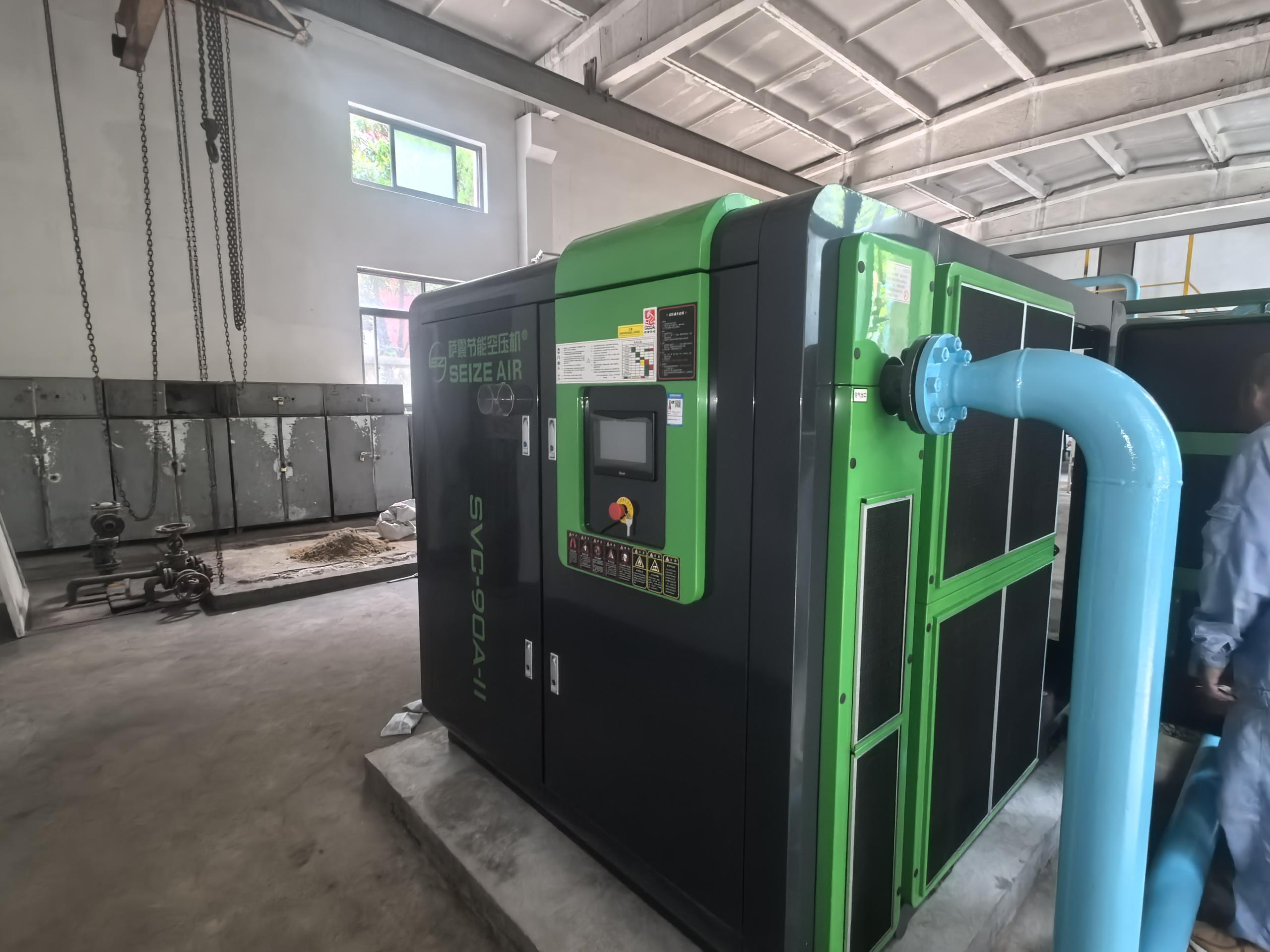
Switching to oil-free compressors eliminates the constant need for lubricant replacement and the energy-sapping pressure drops that clogged oil filters create. Without oil, the internal components glide on precision-engineered coatings, maintaining tighter clearances and reducing power waste over time. That means the motor works less to deliver the same output, which directly shrinks your monthly electricity consumption.
Heat buildup is another silent budget drain. Traditional oil-lubricated units often require additional cooling systems to manage the thermal load from oil churn and friction. Oil-free designs run inherently cooler because the compression chamber stays clean and unobstructed, so the compressor doesn't have to fight its own heat. Less heat means less auxiliary fan or water cooling, cutting secondary energy costs you might not have noticed on your bill.
Plus, actual real-world savings accumulate from reduced maintenance downtime. With no oil changes, separator element swaps, or condensate treatment to schedule, your operations keep humming without planned interruptions. Those hours of lost production add up, and an oil-free compressor keeps them on the profit side of the ledger, making your whole energy profile leaner from start to finish.
Smart Controllers Turn Idle Time into Real Savings
Traditional systems often waste energy during standby periods, running at full capacity when nothing is actually needed. Smart controllers flip that model entirely by sensing real-time demand and dialing down output during idle moments. The result isn't just a slight dip in consumption—it's a fundamental shift where every second of downtime becomes a measurable cost reduction.
These controllers don't simply turn things off; they learn patterns and anticipate gaps in usage. Imagine a manufacturing line that pauses between shifts: instead of humming along at 80% power, the controller cuts back to barely sipping energy, then ramps up precisely when the next cycle starts. The savings accumulate quietly, without any human intervention, turning what used to be wasted time into a steady stream of operational gains.
What sets them apart is the ability to scale this intelligence across entire facilities. One controller might save a bit here and there, but a network of them working in sync transforms idle time into a strategic advantage. Maintenance costs drop because equipment isn't running needlessly, and peak demand charges shrink as the system avoids unnecessary spikes. Over months, those idle moments add up to thousands of dollars that stay in the budget.
Heat Recovery Systems Double Up on Efficiency
Harnessing waste heat has become a quiet revolution in modern engineering. By capturing thermal energy that would otherwise escape through exhaust streams or cooling towers, heat recovery systems can feed it back into industrial processes, building heating, or even power generation. This simple yet elegant approach tackles two challenges at once: it slices energy consumption while also trimming operational costs, making it a natural ally for sustainability goals and lean budgets alike.
What makes these setups particularly clever is how they weave together different forms of heat transfer. A heat exchanger might capture warmth from outgoing boiler gases to preheat incoming cold water, slashing the fuel needed to reach target temperatures. In more advanced configurations, absorption chillers can convert low-grade waste heat into cooling for data centers or food processing, extending the utility of energy that was once deemed useless. This layering of recovery stages multiplies the benefits, often yielding efficiency gains far beyond the sum of individual components.
The real beauty emerges in the numbers: plants that integrate multiple recovery loops can see fuel use drop by 10% to 30%, with payback periods shrinking to just a couple of years. Beyond the spreadsheets, there’s a tangible impact on equipment longevity because preheating and balancing thermal loads reduce stress on boilers and chillers. As industries face tightening environmental regulations and volatile energy prices, these systems offer a pragmatic pathway to doing more with less—quietly pushing efficiency without fanfare or hype.
Low-Pressure, High-Output Models Rewrite the Rules
For decades, the assumption was straightforward: higher pressure meant higher performance. That logic shaped everything from pump design to air compressors, pushing engineers toward heavy-duty systems that guzzled energy and demanded constant upkeep. Then came a quiet shift—models that turned the old equation on its head. By prioritizing flow dynamics and clever internal geometries over brute force, these systems deliver remarkable output while sipping power and shrugging off the wear that plagues their high-pressure cousins.
The real magic lies in how they rethink resistance. Instead of muscling fluids or gases through tight restrictions, they optimize paths, smooth out turbulence, and exploit pressure differentials that were once dismissed as too weak. The result is a machine that runs cooler, lasts longer, and often fits into spaces where traditional units would be laughed out of the room. Industries from HVAC to food processing are taking note, because downtime drops and energy bills shrink without any loss of muscle.
What’s truly disruptive is the ripple effect on system design. When you no longer need to build around high-pressure requirements, pipes can slim down, seals can be less exotic, and safety margins can be rethought. It’s not just an incremental improvement—it’s a permission slip to reimagine workflows from the ground up. The old rulebook sits gathering dust while these low-pressure workhorses quietly prove that output isn’t about force, but about finesse.
Maintenance Tricks That Keep Efficiency from Slipping
A machine running smoothly today can quietly lose its edge tomorrow if you skip the small stuff. Those tiny adjustments you keep meaning to get to—tightening a loose bolt, cleaning a sensor, swapping a filter just before it clogs—don’t feel urgent, but they’re exactly what keep performance from bleeding away. Think of it as housekeeping for reliability; a handful of overlooked details can drag down an entire operation faster than a major breakdown ever could.
The trick isn’t doing more maintenance—it’s doing it before the machine asks for it. Pay attention to subtle shifts: a slight vibration that wasn’t there last week, a belt that squeaks on startup, a temperature reading creeping up half a degree. These are whispers from the equipment, and acting on them early turns what could be a painful repair into a ten-minute fix. It’s about pattern recognition, not panic.
Also, fight the urge to put off the unglamorous tasks. Lubricating joints, checking alignments, flushing out buildup—these aren’t thrilling, but they’re the reason some gear chugs along reliably for decades while identical models end up on the scrap heap. Spacing out those chores with a simple calendar reminder keeps the rhythm alive and prevents efficiency from evaporating into a series of “I’ll do it later” excuses.
FAQ
It comes down to design choices and control methods. Machines with variable speed drives adjust motor RPM to match air demand, so they aren't running at full throttle when it's unnecessary. Efficient internal components—like low-pressure-drop air ends, well-designed coolers, and minimal internal leakage—also play a huge role. Add in smart controllers that learn usage patterns and you'll see real savings.
In many cases, the reduction is substantial—often falling between 30% and 50% on the compressor's portion of the power bill. A small to mid-sized shop operating a 30 HP unit 40 hours a week might save $2,000 to $4,000 annually. The exact figure depends on your local electricity rate, how many hours the compressor runs, and whether your current setup is particularly inefficient.
Not necessarily. Oil-free designs can eliminate the energy loss associated with oil separation and filtration, but high-quality lubricated screw compressors often have better volumetric efficiency at standard pressures. The type of air end, motor efficiency, and control strategy matter far more than whether oil is present in the compression chamber. For most general manufacturing, a well-engineered lubricated unit with a VSD will outperform a basic oil-free model on energy.
They're arguably the most important factor after the compressor's core hardware. A unit with a basic stop/start or load/unload control will waste energy during partial loads. In contrast, a compressor with a variable speed drive and a master controller that coordinates multiple units can trim power use dramatically. Real-time monitoring allows you to spot leaks, pressure drops, and inefficiencies before they inflate the electricity bill for weeks.
VSD isn't a universal answer. If your air demand is constant and close to the compressor's max output, a well-sized fixed-speed machine can run near its optimum efficiency point and cost less to buy. However, if demand fluctuates—which it does in most factories—the VSD advantage becomes clear. You have to look at your load profile: a compressor running 60% loaded on average will usually see a payoff from VSD within a couple of years.
Look beyond the badge efficiency rating. Pay attention to the total package performance at common operating pressures. Key indicators: a high-efficiency motor (IE4 or IE5), an oversized integrated dryer that reduces pressure loss, variable speed drive with a wide turndown ratio, and a control panel that offers trending and time-of-day scheduling. Also, check the sound level—quieter machines often have better interior airflow and tighter tolerances that correlate with lower waste.
Don't stretch out service intervals beyond what the manufacturer recommends, even if the machine seems to be running fine. Air and oil filters that are partially clogged force the compressor to work harder; dirty coolers raise the discharge temperature and reduce efficiency. A good rule is to inspect weekly for leaks and pressure drops, and follow the OEM's schedule for fluid changes and separator replacements—typically every 2,000–4,000 hours for most rotary screw units.
Neglecting the distribution system. You can buy the most efficient compressor on the market, but if your piping is undersized, full of sharp bends, or riddled with leaks, the system will still waste power. Another mistake is setting the pressure higher than needed—every 2 psi of excess pressure adds about 1% to energy consumption. Always start by sizing the compressor correctly, fixing leaks, and optimizing the pressure settings before judging the machine itself.
Conclusion
Variable speed drives adapt compressor output to real-time air demand, eliminating wasteful full-throttle running and trimming power consumption by up to 35%. Pairing this with oil-free technology not only cuts lubricant-related maintenance but also sustains high volumetric efficiency, keeping energy bills lean over the compressor's lifetime. Smart controllers push savings further by mapping usage patterns, automatically shutting down during predictable idle windows, and seamlessly restarting when demand returns—turning what used to be wasted standby power into measurable cost reductions.
Heat recovery systems repurpose the thermal byproduct of compression to preheat water or facility air, effectively doubling the return on every watt consumed. Meanwhile, low-pressure, high-output models challenge conventional thinking by delivering full cubic feet per minute at reduced bar levels, matching many production environments' actual needs while drawing less current. Real-world performance doesn't stop at the spec sheet, though—simple maintenance habits like timely filter changes, leak audits, and cooler cleaning arrest the slow efficiency drift that silently inflates power bills month after month.
Contact Us
Contact Person: Mia
Email: [email protected]
Tel/WhatsApp: +86 19821985894
Website: https://www.seize-air.com