

ODM LED Signal Light Bulb: Custom Manufacturing Solutions for Reliable Illumination
2026-08-13
Signal lights live at the edges of our attention—until one fails. For fleets, industrial facilities, and specialty vehicles, a bulb that quits early is more than an inconvenience; it's a safety risk. That's why off-the-shelf LED replacements often fall short. They aren't built for your exact fixture, voltage swings, or duty cycles. ODM LED signal light bulbs change that equation. Instead of forcing your application to fit a generic part, the bulb is engineered around your requirements. LUXFIGHTER takes this custom approach further, pairing precise manufacturing with rigorous reliability testing. In this post, we'll unpack how tailored ODM solutions deliver the dependable illumination your operations can't afford to lose.
Turning Your Specs into a Production-Ready LED Signal Bulb
Most spec sheets are a wish list. Turning them into a bulb that actually survives the road means interrogating every number before it reaches the drawing board. Voltage range? That 12V nominal claim falls apart at 9V cold crank or 16V load dump. Current draw? It's not just brightness, it's thermal budget. A signal bulb that looks great on a bench can cook itself inside a sealed tail lamp. So the first step is sorting the must-haves from the marketing numbers and pinning down the real operating envelope.
From there, the work moves to component selection and mechanical fit. The emitter, driver, and housing all have to agree with each other. A high-output LED on paper means nothing if the PCB cannot shed heat or the base tolerances let it rattle loose. Prototyping is where the gaps show up. Production is where those gaps get expensive. Lock the design with derating, test at the corners of the spec, and only then call it ready.
Material and Thermal Decisions That Keep Signal Bulbs Bright for Years
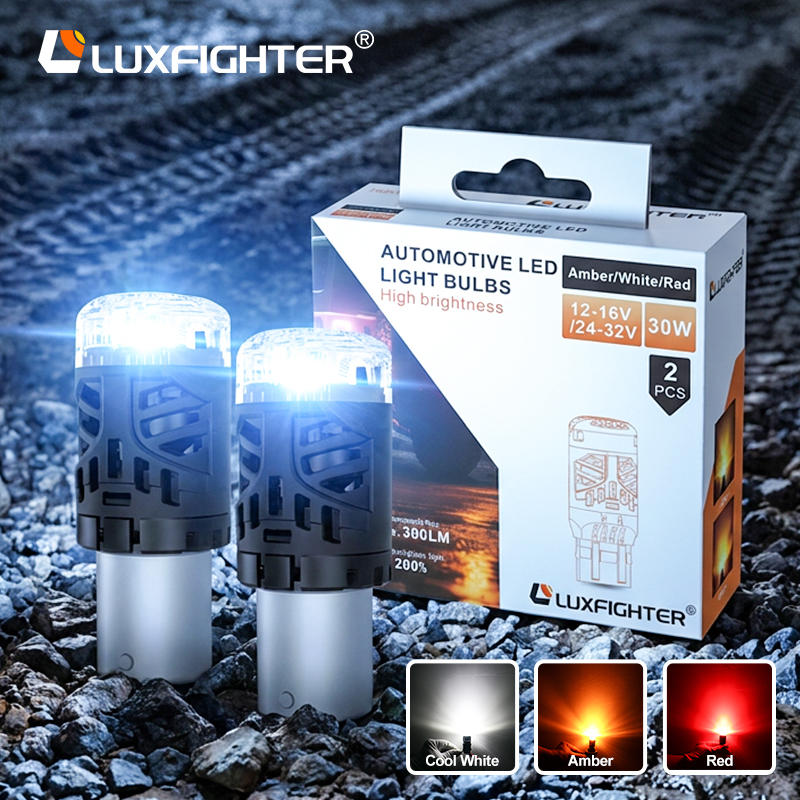
A signal bulb's outer lens and base do more than hold parts together. High-temperature nylon or ceramic bases keep their shape after thousands of hot-cold cycles, while UV-stabilized polycarbonate lenses resist the yellowing that slowly dims older plastic. Silicone gaskets and potting compounds seal the seam between glass, metal, and polymer so moisture never reaches the emitter.
Inside, the main heat path runs from the LED's copper slug through a thermal pad into an aluminum or graphite heat spreader. This pulls heat away from the junction fast enough to keep the chip below roughly 85°C under continuous use. Without that path, soldered connections would fatigue, and the phosphor layer would degrade, cutting output long before the bulb actually fails.
On the driver side, current-limiting circuits are set conservatively—not to squeeze out the last few lumens, but to lower waste heat and extend LED life. High-melting-point solder alloys and thick copper traces on the PCB survive repeated thermal expansion, so a hot bulb at a red light doesn't crack a joint. Together these choices let a signal bulb hold most of its brightness for 50,000 hours or more.
Compatibility Engineering Across Automotive, Marine, and Industrial Systems
Compatibility engineering across these three domains rarely starts with a shared specification. Automotive teams optimize for vibration profiles of potholed roads and temperature swings from -40°C to 85°C, while marine designers battle salt fog, constant humidity, and galvanic corrosion. Industrial systems face their own mix: high-duty cycles, conductive dust, and unpredictable mains power. A practical approach is to define a common mechanical envelope and thermal budget that satisfies the harshest condition in each category, then relax specific tests for lighter environments. This prevents costly redesigns when a controller originally built for factory automation gets repurposed on a fishing vessel or an off-highway truck.
Electrical and protocol compatibility often becomes the hidden bottleneck. A modern car relies on CAN FD and automotive Ethernet, while marine electronics still lean heavily on NMEA 2000 and J1939 for engine data. Industrial PLCs speak EtherCAT, PROFINET, or Modbus TCP, with different voltage thresholds and grounding philosophies. Rather than forcing one bus across all sectors, a better strategy is to isolate the application logic behind a hardware abstraction layer and use compact gateway modules that translate signals at the edge. This keeps core firmware stable while adapting to the connector pinouts, baud rates, and fail-safe states each industry expects.
Validation must also be rethought when one product family spans three environments. Testing only to automotive ISO 16750 will miss the 500-hour salt spray requirement common in marine type approval, while industrial EMC standards like IEC 61000-6-2 impose different transient immunity levels. Leading teams run a combined test matrix that overlays worst-case vibration, humidity, and surge conditions early in prototyping, then use accelerated life testing to catch material mismatches. Modular enclosures with replaceable seals and conformal coating options let the same electronics meet IP67 on a boat deck, IP65 in a dusty factory, and IP69K under a truck chassis without changing the internal layout.
The Testing Gauntlet Every Custom Signal Bulb Passes Before Shipping
A custom signal bulb isn't declared ready just because it lights up on the bench. Each unit gets pushed through a sequence that feels less like inspection and more like an interrogation. Voltage gets swung high and low while the bulb is already hot, then again after a cold soak, just to see if the solder joints flinch. Vibration tables shake it at frequencies that mimic a thousand miles of washboard road. The filament or LED array has to hold its position, not drift, not buzz, and keep its color within a tolerance tighter than most driver's eyes could ever notice.
Then comes the humidity chamber, where weeks of condensation are compressed into a single afternoon. After that, the bulb is dunked, dried, and powered back up without a pause. Only when a batch survives all of this do we pull individual samples for the final gut-check: a 72-hour continuous burn at maximum rated output. If the light so much as flickers or the base warps, the whole lot goes back. That's the gate every single custom signal bulb has to clear. No exceptions, no shortcuts.
From First Sketch to Pilot Run: A Faster Path Without Cutting Corners
Turning a rough napkin sketch into a pilot-ready unit used to mean months of waiting for tooling, testing, and a long list of design revisions. The faster route isn't about skipping validation—it's about running it in parallel. Suppliers get involved before the CAD model is even fully constrained, so their feedback on draft angles or material flow shapes the part before it hardens into a costly mistake.
At the same time, digital twins and quick 3D-printed fit checks replace weeks of back-and-forth spec documents. You still run the same battery of stress, thermal, and lifecycle tests, but you do it on parts that already reflect manufacturability. That means fewer surprises at the pilot line, where every adjustment costs ten times more than it did on screen.
The real discipline is deciding what can be overlapped and what can't. Critical safety or compliance gates stay sequential, but everything else—DFM reviews, packaging studies, even early regulatory conversations—moves forward at once. The result is a pilot run that feels less like a first draft and more like a rehearsal, because you've already rehearsed the hard parts.
Scaling Up with ODM: Consistent Quality from First Batch to Last
Moving from prototype to full production often exposes hidden inconsistencies that small runs never reveal. With a well-structured ODM partnership, those risks aren't left to chance. The manufacturer's established processes, component sourcing, and tight quality gates stay the same whether you're ordering 500 units or 50,000. That continuity means the first batch out of the line and the last one packed months later should feel identical to your customer.
A reliable ODM doesn't treat scaling as a one-time event. They audit incoming materials against the same specs, keep production line settings locked, and run inline checks at fixed intervals rather than relying on a final inspection alone. This kind of repeatable control is what prevents the slow drift that often shows up as slightly different finishes, looser tolerances, or changed firmware behavior after a few production runs.
What really sets consistent ODMs apart is how they document deviations and corrections. If a batch does show a minor shift, the record trail lets the team trace it back to a specific material lot or machine calibration, fix it at the source, and confirm the next run returns to baseline. That closed loop is what makes scaling feel less like a gamble and more like a repeatable operational rhythm.
FAQ
It means we handle the entire design and manufacturing process based on your specifications. You provide the functional requirements—brightness, color, base type, voltage—and our engineering team creates a bulb that fits your equipment, rather than you adapting to an off-the-shelf product.
Yes, custom voltage and base options are a core part of the service. Whether you need 12V DC, 24V AC, or a less common bayonet or wedge base, the design is built around your existing socket and power supply to avoid rewiring.
We focus on three areas: thermal design that pulls heat away from the LED junction, sealed housings that keep out moisture and dust, and component derating so the bulb operates well below maximum stress. Each batch is tested for lumen maintenance and vibration tolerance.
They are used in traffic signals, railway indicators, marine beacons, and industrial status panels. The common thread is continuous or intermittent duty in outdoor or harsh conditions, so we assume exposure to temperature swings, humidity, and vibration during design.
Yes, we typically build a small pre-production run for your evaluation. You can test fit, brightness, and electrical behavior in the actual fixture. Adjustments are made at this stage before committing to full tooling and volume output.
Depending on the target market, testing covers electrical safety, ingress protection, color coordinates, and thermal cycling. We can also arrange third-party certification such as CE or UL if your project requires it, though the specific standards depend on the end application.
Minimums vary based on the complexity of the design and the tooling involved. For simple base and voltage adaptations, smaller batches may be possible. For fully custom housings or optics, we usually need a larger commitment to justify mold costs.
You can be as involved as you like. Some clients hand us a spec sheet and wait for the prototype, while others join weekly design reviews, request specific LED bins, or provide their own lens files. Communication is direct with the engineers, not through layers of sales support.
Conclusion
Turning a signal bulb from a rough spec into something that survives daily vibration and voltage swings takes more than just matching dimensions. The process starts by locking down beam pattern, socket retention, and current draw before the first prototype is milled, so the engineering team isn't guessing downstream. From there, every material choice gets weighed against heat buildup rather than upfront cost alone: an aluminum-core board and high-temperature solder can keep junction temperatures low enough that the bulb won't drift toward yellow or fail after a few thousand hours. That same thinking carries into compatibility work where a single housing style often needs to behave across 12V automotive circuits, 24V marine panels, and industrial controllers with messy transients. Instead of forcing one driver design onto every application, the electronics are tuned per platform, then pushed through a gauntlet of thermal soak, salt spray, and vibration profiles that replicate years of abuse in a few weeks.
What makes the ODM path distinct is the way prototyping and pilot runs feed directly into mass production without losing the intent of the original design. Early DFM reviews catch the small tolerance issues that would otherwise show up as intermittent flicker in the field, and a pilot run of a few hundred units gets measured against the same pass/fail thresholds as the first article. Once those results are locked, the line ramps with inline optical checks and batch-level burn-in rather than relying on random sampling. The result is a custom signal bulb that doesn't just pass a lab test but keeps performing the same in the field, from the first container to the last, whether that bulb ends up in a forklift warning light, a navigation panel, or a brake lamp housing.
Contact Us
Contact Person: Gavin Chen
Email: [email protected]
Tel/WhatsApp: (+86)756-6831079
Website: https://www.luxfighter.com/