

Leather Rivets Wholesaler Buying Guide for Quality Bulk Supplies
2026-09-08
Bulk leather rivet orders go wrong in predictable ways: soft brass that bends instead of sets, nickel plating that peels within weeks, or mismatched cap sizes that jam your press. This guide is built for buyers who need to separate reliable suppliers from the rest—without wasting money on samples. You'll learn the key specs that determine rivet performance, how to audit a wholesaler's quality claims, and why proven brands like Kingming have become a go-to for shops that refuse to compromise on finishing quality.
Matching Rivet Material to the Leather You Actually Use
Vegetable-tanned leather and brass rivets are a classic pairing for a reason that goes beyond looks. The tannins in veg-tan react slowly with copper-based alloys, and if the leather gets damp, that reaction can leave a dark halo around the rivet over time. Some makers love that aged, lived-in ring; others want it to stay clean. If you are in the latter camp, try nickel-plated brass or solid stainless steel instead, because they sit more quietly against the grain and will not develop the same patina as quickly.
Chrome-tanned and oil-tanned leathers are less reactive, so you have more freedom there. Solid brass still works, but if you are after a cooler, more modern finish, stainless steel or nickel rivets hold their brightness without fighting the leather's chemistry. Avoid cheap zinc or mystery-metal rivets on anything you expect to flex a lot, because soft rivets can bend, crack, or leave gray streaks on the surface when the leather moves. If the leather is especially thick or stiff, pick a rivet with a slightly longer post and a wider burr, and match the metal hardness to the job rather than just the color.
Decoding Shank Lengths and Cap Styles for Different Leather Thicknesses
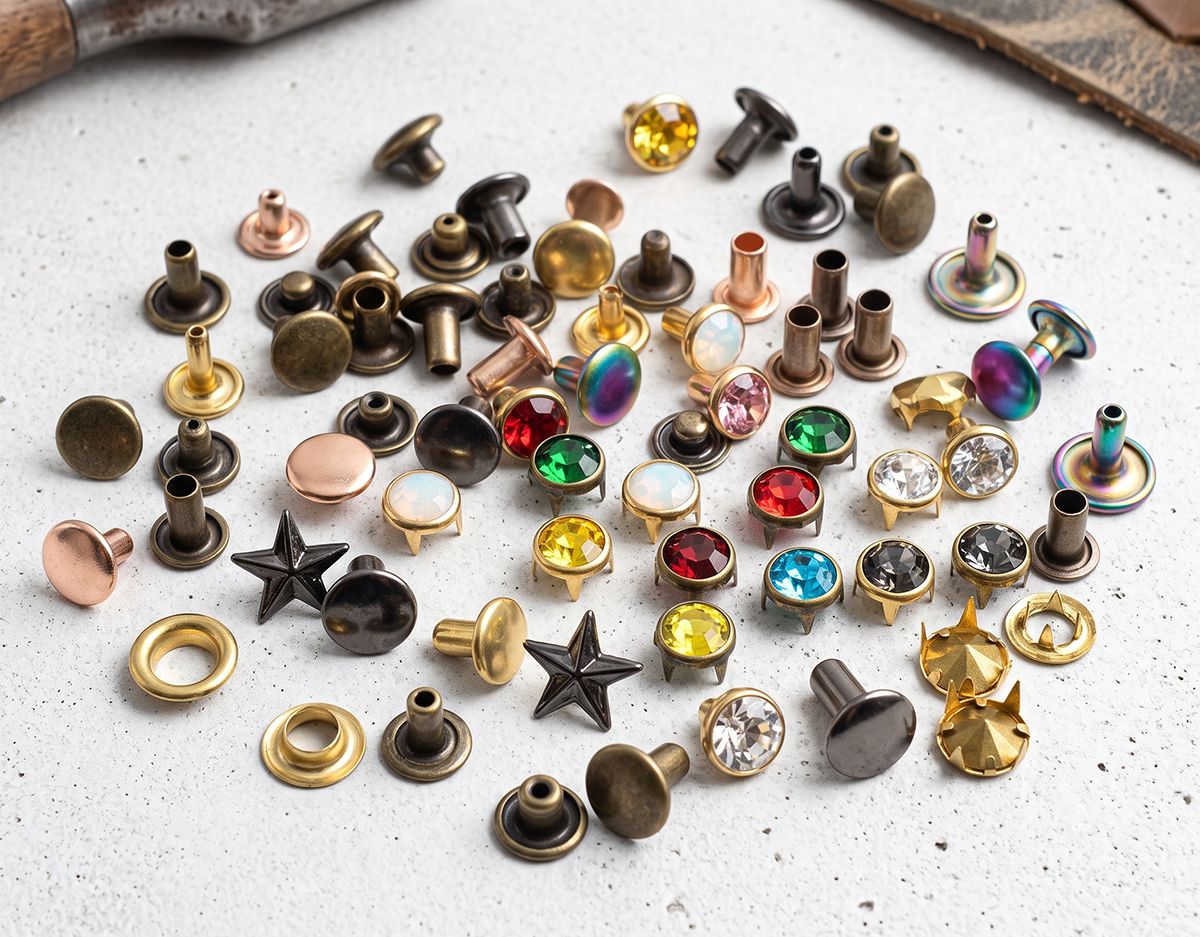
Leather thickness dictates more than just the feel of a finished piece; it quietly sets the boundaries for hardware choices. When the hide runs thin, a long shank becomes a liability because it can press through the back or create an unsightly bump under the surface. Shorter shanks keep the structure close to the material, while low-profile caps prevent the hardware from overpowering the leather’s natural flex.
For mid-weight hides in the 2 to 3 mm range, you get room to experiment. A medium shank length bridges the gap between support and concealment, and a slightly domed cap can add visual weight without turning the piece into a hardware display. Thicker leather, say 3.5 mm and up, actually wants a longer shank to anchor securely through the dense fiber, and a taller cap style works because the surrounding material absorbs the extra height instead of letting it poke through.
The trick is to test on scraps before committing. Press the assembled hardware into the leather at the angle you plan to use, then flip it over and run your thumb across the back. If you feel any sharpness or see a ghost of the shank, step down half a size in length or switch to a flatter cap. Different leathers react differently, so treat these pairings as a starting point rather than a fixed chart.
How Bulk Weight Breaks Change Your Real Cost Per Rivet
Most buyers fixate on the sticker price per thousand rivets and stop there. That number looks clean on a spreadsheet, but it rarely survives contact with an actual purchase order. Bulk weight breaks—those tiered discounts that kick in at 50, 100, or 500 pounds—quietly rewrite the math. A rivet that costs $0.012 at 10 pounds might drop to $0.008 at 250 pounds. The real question isn't what you pay per rivet on paper, but what you pay after freight, handling, and line-side storage are factored in. Weight breaks change all three at once.
Consider what happens when you jump from a light carton to a full pallet. Freight per pound falls, but you're now carrying weeks of inventory instead of days. If your product mix shifts or a design change obsoletes that rivet, the savings evaporate into scrap. Smaller shops often learn this the hard way: they chase a lower unit cost and end up funding a warehouse shelf. The smarter move is to map your actual consumption rate against each weight tier. For a line using 8,000 rivets a week, the 200-pound break might make sense. For a prototyping cell using 900, the same discount is a trap.
There's also the matter of how those breaks are priced. Some suppliers compress the curve—modest drops at 50 and 100 pounds, then a cliff at 500. Others spread it evenly. Ask for the full tier schedule before you commit. Then run the numbers with your own freight rates, not the published ones. A five percent price cut at 300 pounds can vanish under a single LTL surcharge that a smaller shipment wouldn't trigger. The real cost per rivet is never the number on the quote. It's what leaves your bank account for every rivet that actually gets installed.
Spotting Red Flags in Supplier Minimums and Lead Times
A minimum order quantity that seems too good to be true usually is, especially when the product involves custom tooling or specialized materials. If a supplier quotes 100 units for something that realistically requires a production run of 1,000 to amortize setup costs, they may be planning to use off-the-shelf components, skip important finishing steps, or absorb the loss just to win your first order. Ask for a cost breakdown tied to the MOQ. Vague answers about ‘economies of scale’ without numbers are a sign you'll pay for it later in rejects or delays.
Lead times deserve the same scrutiny. A blanket ‘7 to 10 days’ for made-to-order goods is often a placeholder, not a production plan. Serious suppliers quote lead times that start after raw material arrives, not from the moment you sign the PO. When a vendor cuts their standard lead time in half after you hesitate, find out what changed. Did they suddenly free up capacity, or did they just move your order ahead by pushing someone else's back? The latter means your next order will likely slip.
The real red flag is when minimums and lead times start moving in ways that don't match the product's complexity. If a supplier lowers the MOQ but extends delivery from four weeks to ten, they may be batching your tiny order with other customers' runs, which means your ‘custom’ items get whatever leftover machine time is available. Similarly, a supplier who accepts a lower MOQ only if you prepay in full is often financing their own material purchases. Check past purchase orders for similar items, or ask to see the production schedule before you commit. If they can't show you how your order fits into their existing workload, assume the dates are negotiable fiction.
Building a Quick Inbound Inspection Routine for Bulk Orders
When a large shipment arrives, the instinct is often to check everything at once, but that quickly turns into a time sink. Instead, start with a tiered sampling approach: open a set number of cartons from different pallets, not just the top layer, and focus on the items most likely to have issues from past orders—things like fragile parts or custom-labeled pieces. Set a timer for each stage so inspection doesn't balloon into an all-day task. If the first sample passes cleanly, reduce the number of boxes you open from the remaining pallets. If you find a problem, expand the sample size immediately before moving on.
A quick inbound routine lives or dies by its checklist. Keep it to one page, with visual cues rather than long paragraphs. For bulk orders, the checklist should cover three things only: correct item count per carton, visible damage on outer packaging and inner wrapping, and label accuracy (SKU, barcode, and any country-of-origin marks). Skip cosmetic checks that don't affect function, or you'll end up rejecting good stock. Have a pre-printed reject tag ready, and note the exact carton number and pallet ID so the supplier can trace the batch without back-and-forth emails.
Finally, make the routine repeatable by assigning one person to run it for the whole week, then rotate. Hand the checklist to someone who didn't write it and watch where they pause or ask questions—those friction points are where mistakes hide. At the end of each day, spend five minutes logging only the anomalies, not the passes. Over two or three weeks, you'll see patterns: a particular carton size always arrives crushed, or one product line always has label smudges. That's when you adjust the routine—fewer samples for reliable suppliers, more for the problem ones.
Negotiating Pricing Tiers Without Sacrificing Plating Quality
When buyers push for lower per-unit costs, the first instinct is often to strip back finish specifications. That rarely ends well. Instead, start by separating the plating quote into its actual layers: metal substrate prep, anode material, bath chemistry, labor, and QC time. Suppliers usually have more room in labor scheduling or bath utilization than in the metal itself, so asking for a tiered break based on batching, not downgraded thickness, keeps the finish intact.
A practical lever is committing to a narrower range of part geometries or a steadier monthly volume. Platers price in setup and drag-out losses, so if you can guarantee that a line runs the same alloy for longer stretches, the per-rack cost drops without touching the plating spec. Tie that commitment to a written quality clause: define minimum thickness at specified points, adhesion test frequency, and salt spray hours. Then request a price reduction against those exact parameters, not against a looser standard.
Finally, don't accept a "better" tier that quietly substitutes a cheaper nickel or trims post-plate sealing. Ask for the current production sample and the proposed cost-down sample side by side, then run both through your incoming inspection. If the supplier cannot show where the saving comes from without altering the deposit, the negotiation isn't finished. The goal is a lower price for the same measurable outcome, not a lower price for a different product.
FAQ
Ask for a physical sample pack first, not just photos. Check the rivet heads for burrs, uneven plating, and weak shank material. Pull a few test rivets through scrap leather to see if they set cleanly without splitting. Also confirm the wholesaler can hold the same batch color and size across repeat orders, because slight alloy shifts can change the finish more than you'd expect.
Request a material certificate or cut one rivet in half. Plated steel has a silver core; solid brass is uniform gold all the way through. You can also use a magnet—solid brass won't attract it, but plated steel will. For coated or antique finishes, ask which base metal is used and whether the coating is lacquered to prevent tarnishing.
Many wholesalers set MOQs between 1,000 and 10,000 pieces per size, depending on whether they stock standard items or run custom tooling. If you need mixed sizes, ask if the MOQ applies per line or across the whole order. Smaller makers can often negotiate a slightly lower MOQ by paying a small setup fee or accepting longer lead times.
Tubular and cap rivets with a washer or burr tend to handle stress better than single-cap rapid rivets. Look for a shank diameter of at least 9mm for thick straps, and choose a post length that leaves about 2-3mm extra before setting. Hand-peened solid copper or brass rivets are the most durable but slower to install, so match the style to your production speed.
Break the quote down to cost per piece, but also factor in shipping weight, packaging, and any import duties. Ask each supplier to quote the same alloy, finish, and shank length so you're not comparing apples to oranges. A slightly higher unit price can be cheaper overall if the wholesaler pre-sorts defective rivets or offers better bulk packaging that reduces damage in transit.
Look for inconsistent head diameter, off-center shanks, cracked plating, and burrs that snag thread or scratch leather. Open a few random boxes and count a small sample—if more than 1-2% show visible flaws, ask for a credit or replacement. Also check that the finish matches the approved sample under indoor lighting, not just in the warehouse.
Yes, many offer custom plating, powder coating, or antique finishing, but the lead time usually jumps from a few days to 4-8 weeks. Custom finishes often require a minimum batch size because the plating line has a setup cost. Ask if the finish is applied in-house or subcontracted, because outsourcing adds extra transit and quality control steps.
Look for a clear defect policy: replacement or refund for flawed pieces, not just a vague "quality guaranteed" line. Good wholesalers keep batch samples for reference and can trace problems back to a specific production run. If they proactively send a new sample when they change suppliers or materials, that's a sign they understand how finish shifts affect your work.
Conclusion
When you buy rivets in bulk, the first thing that separates a smart order from a costly mistake is how well the metal matches the leather you actually cut every day. Brass, nickel, and antique finishes each behave differently against vegetable-tanned, chrome-tanned, or oiled hides, so test a small batch before committing. Shank length is equally easy to overlook: a cap that sits flush on 8-ounce leather will wobble or tear through 3-ounce lining if you don't check the post height. Once you've nailed the specs, pay attention to how weight breaks are structured. A quoted price per thousand often drops sharply at 5,000 or 10,000 pieces, but shipping and storage fees can eat that margin if you overbuy.
Beyond the rivet itself, supplier behavior tells you more than a catalog ever will. Watch for minimums that force you into dead inventory, or lead times that shift after you've paid. A quick inbound inspection routine—checking shank alignment, cap plating adhesion, and box counts—takes minutes but prevents a full production stop. When you negotiate pricing tiers, don't let the conversation drift to cheaper base metal or thinner plating. Plating quality is where hidden corrosion and finish wear show up later, so push for volume discounts on the same spec instead. Treat the whole process as a supply chain habit, not a one-time search.
Contact Us
Contact Person: Jamie Zeng
Email: [email protected]
Tel/WhatsApp: +86 13728219269
Website: https://www.kmhardware.com