
China Boron Carbide Tiles: Advanced Ceramic Armor for Ballistic Protection
2026-11-02
Ballistic protection used to mean piling on steel and hoping for the best. Today, the smart money is on ceramics that can shrug off high-velocity impacts while keeping weight down—and boron carbide tiles are leading that shift, with Chinese manufacturers at the center of innovation. Among them, HUAYI TECH stands out for its focus on advanced ceramic armor. What makes boron carbide so effective, and where does HUAYI TECH fit into the bigger picture? Let’s dig in.
Ballistic Performance Beyond the Data Sheet: Boron Carbide Under Real Impact
A material data sheet will list hardness, density, and flexural strength, but none of those numbers capture what happens when a projectile strikes boron carbide at several hundred meters per second. Under real impact, the ceramic does not simply resist penetration through static stiffness; it shatters in a controlled, progressive manner, converting kinetic energy into fracture surface area and thermal spikes. That transition from intact solid to confined granular bed happens in microseconds and depends heavily on grain size, binder phases, and even the exact pressing direction of the tile—variables rarely shown on a typical spec page.
What separates adequate armor from exceptional armor often emerges long after the first shot. Multiple hit performance, residual tensile stress around the impact zone, and how the damaged ceramic interacts with a backing composite cannot be inferred from a simple Knoop hardness value. Boron carbide's low density is a known advantage, but its tendency to localize amorphous shear bands under high pressure can either blunt a threat or create a plug that travels with the projectile, depending on the impact geometry. These behaviors only become visible through instrumented ballistic tests and post-impact microscopy, not through standard laboratory coupons.
Field-relevant testing also reveals trade-offs that controlled lab measurements overlook. Variations in tile curvature, edge confinement, and adhesion to the spall liner shift the failure mode from comminution to radial cracking, altering energy absorption more than a 2% difference in stated modulus ever would. Engineers who rely solely on published values often miss the importance of through-thickness wave propagation and interface defeat, where boron carbide's real merit is decided by whether the striker is eroded and deflected rather than cleanly perforating the tile.
Why Chinese Boron Carbide Tiles Are Gaining Ground in Ceramic Armor
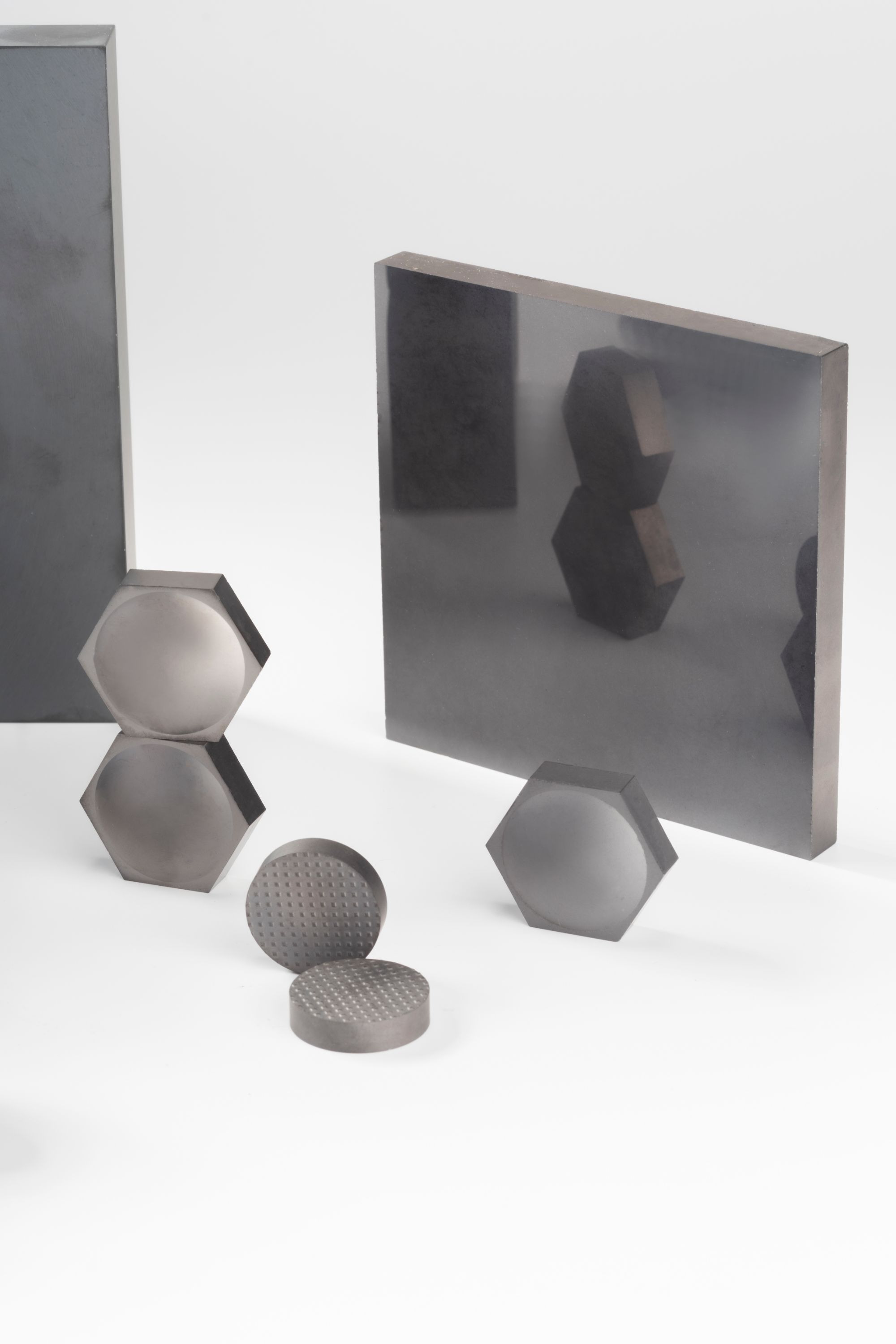
Chinese manufacturers have quietly refined the production of boron carbide tiles to a point where they now rival long-established Western suppliers on both consistency and cost. The dense, ultra-hard ceramic offers an exceptional stiffness-to-weight ratio, allowing armor designers to shave kilograms from vehicle or body armor without sacrificing multi-hit performance. Advances in sintering and hot-pressing techniques across several industrial clusters in Zhejiang and Shandong have narrowed the porosity and grain-size variations that once plagued lower-cost alternatives. This tighter process control means fewer rejected plates, more predictable ballistic outcomes, and a growing willingness among procurement agencies to look beyond legacy vendors.
Part of the appeal lies in how readily these tiles integrate into hybrid ceramic-composite systems. By pairing a thin boron carbide strike face with a polymer or metallic backing, integrators can tune the armor package for specific threats—from high-velocity rifle rounds to fragmentation—while keeping the overall areal density remarkably low. Chinese suppliers have also become more responsive to custom tile geometries, offering near-net-shape pressing that reduces edge grinding and lowers assembly labor. This flexibility, combined with shorter lead times than many European counterparts, has shifted the calculus for integrators who once viewed boron carbide as a premium material reserved for only the most demanding applications.
Another factor driving adoption is the gradual maturing of raw material supply chains within China. Domestic sources of boron-rich ores and carbide precursors have expanded, insulating production from the price volatility that hit the market during previous supply crunches. As a result, the cost per kilogram of finished tile has dropped to a level where boron carbide can replace silicon carbide in a broader range of vehicle up-armoring kits and personal protection plates. Field reports from testing laboratories and end users increasingly note that the newer Chinese tiles deliver the same V50 thresholds and multi-hit spacing as traditional grades, but at a price point that makes ceramic armor economically viable for wider deployment.
The Sintering Process That Separates Durable B4C Tiles from Brittle Ones
Not every B4C tile emerges from the furnace with the same chance of surviving a high-energy impact. The sintering cycle itself is where that split happens. Powder size, heating rate, peak temperature, dwell time, and applied pressure all shape how the boron carbide particles fuse. A rushed or uneven cycle leaves behind pores and weak grain boundaries that become crack paths. A carefully controlled profile lets the grains lock together tightly without runaway growth, producing a dense body that resists fracture.
Hot pressing and spark plasma sintering tend to yield the most durable tiles because they apply pressure while the material reaches its narrow densification window, typically between 2000°C and 2200°C depending on additives. Sintering too low leaves the compact under-densified and full of open porosity, making it easy to snap. Sintering too high or holding too long triggers abnormal grain growth and carbon loss, which also makes the tile brittle even if it feels hard. Additives like carbon or silicon carbide can widen the processing window, but even a slight overdose creates weak secondary phases at grain boundaries.
What separates a dependable tile from a fragile one often shows up only under a microscope. Durable B4C tiles reach near theoretical density, usually above 98%, with fine equiaxed grains and no interconnected porosity. Brittle tiles, by contrast, carry residual pores clustered at triple junctions or show a bimodal grain structure with a few oversized grains acting as weak points. That is why two tiles with the same nominal hardness can perform very differently in a ballistic test. The durability is not added afterward—it is set during those few minutes at peak temperature.
Multi-Hit Capability: What Buyers Should Demand from Ceramic Armor
Multi-hit capability is less about how many rounds a plate can stop and more about how much of the ceramic remains intact after the first strike. Buyers should evaluate the strike face design—segmented or tiled ceramics often localize damage better than large monoliths, which can develop cracks that spread beyond the impact point. A ceramic plate that survives a single high-velocity hit but loses structural integrity over a wide area is not truly multi-hit ready.
Demand detailed test documentation that includes shot spacing, projectile type, velocity, and the condition of the plate after each impact. Look for results where hits are placed close to the edge or near previous strikes, since these are the failures most often hidden by centre-mass-only testing. The backing material matters too: a stiff, well-bonded composite backing can hold fractured ceramic fragments in place and preserve some level of protection for subsequent hits.
Finally, avoid blanket phrases like "multi-hit rated" unless the vendor specifies the exact protocol. Ask whether the plate was tested under NIJ 0101.07 multi-hit requirements or a comparable standard, and request the shot map and backface deformation values for every round. If that data is not available, the multi-hit claim is only a surface-level promise rather than an engineering result.
Weight, Thickness, and Coverage: Designing with Boron Carbide Tiles
Boron carbide tiles bring a unique balance to protective systems—light enough to avoid overburdening the wearer, yet dense enough to stop high-velocity threats. When choosing a tile, weight per unit area often dictates how many tiles can be integrated before mobility suffers. A typical hot-pressed boron carbide plate might come in at around 2.5 g/cm³, a fraction of alumina or steel equivalents, allowing designers to add coverage without pushing the total load past ergonomic limits.
Thickness plays a quieter but equally critical role. Thinner tiles, often 5–8 mm, keep profiles slim for covert vests or vehicle liners, while thicker sections up to 12 mm extend protection against armor-piercing rounds. The trade-off is rarely linear: every added millimeter buys stopping power but costs weight and flexibility. Successful designs treat thickness as a dial that tunes both multi-hit capability and the risk of edge chipping under oblique impact.
Coverage, then, becomes a puzzle of geometry rather than simple surface area. Boron carbide's brittleness means large monolithic panels tend to crack at stress concentrators, so many applications favor smaller tiles with overlapping or interlocking edges. This segmentation lets the armor follow body contours or curved hulls, while the slight gaps absorb shock without transmitting cracks across the whole assembly. Getting the weight-thickness-coverage triad right is less about hitting a spec sheet and more about understanding how the tiles will actually fail in the field.
From Lab Testing to Field Use: Validating Chinese Ceramic Armor
Laboratory tests can only tell you so much. A ceramic plate might stop a standardized projectile under controlled conditions, but real-world use involves uneven wear, sudden temperature swings, and impacts that arrive from odd angles. Chinese ceramic armor development has had to move beyond the clean confines of a shooting range, pushing prototypes into environments where dust, moisture, and rough handling are part of the daily routine.
The transition from lab bench to field trial has meant strapping plates onto soldiers during extended exercises in coastal humidity, high-altitude cold, and desert heat. Some early batches showed micro-cracking after repeated low-velocity drops, while others lost a fraction of their protective edge when saturated with sweat and rain. Those failures didn't show up on the initial spec sheets, but they forced manufacturers to adjust binder formulations and edge sealing techniques.
Actual field use has also reshaped how the armor is judged. Beyond ballistic limits, troops care about weight distribution, breathability, and how the plate sits under a load-bearing vest for twelve hours. Feedback from border units and peacekeeping rotations has led to subtle changes in curvature and attachment points, making the ceramic inserts less noticeable during long patrols. Validation now isn't a single certificate from a lab; it's a running tally of performance under real strain, with each deployment adding another layer of confidence.
FAQ
Boron carbide offers one of the highest hardness-to-weight ratios among armor ceramics, so it stops high-velocity projectiles while keeping the overall protective system lighter than alternatives like alumina.
Tiles from established Chinese producers are often tested to standards such as NIJ Level III or Level IV, and many show consistent multi-hit capability with minimal cracking outside the impact zone.
These tiles are commonly used against rifle rounds, including 7.62mm AP and similar threats, depending on tile thickness and backing design.
The key advantage is lower density; at the same areal weight, boron carbide can provide better protection or allow a lighter plate, which matters a great deal for wearable armor.
Thickness determines the energy absorption capacity of the ceramic layer, while the backing material catches fragments and spreads residual load, so both must be engineered together for reliable protection.
Most producers offer square, hexagonal, and custom-curved tiles, with typical side lengths ranging from 50 mm to 150 mm and thicknesses between 5 mm and 12 mm depending on the threat level.
Look for batch consistency, density above 2.5 g/cm³, evidence of ballistic certification, and clear documentation of raw powder sources and sintering methods.
Hot pressing and pressureless sintering are the two main routes; hot-pressed tiles usually reach higher density and finer grain structure, which improves hardness and fracture toughness.
Conclusion
Ballistic data sheets rarely capture what happens when a boron carbide tile meets an actual projectile at slight obliquity or after rough handling. Chinese manufacturers have begun to close this gap by pairing pressureless sintering with hot isostatic pressing, yielding B4C tiles that hold together under repeated hits rather than shattering after the first round. The distinction shows up most clearly in multi-hit testing: tiles are spaced and backed to absorb energy across adjacent strike points, and the best suppliers now provide high-speed video and post-shot micrographs instead of blanket V50 claims. This kind of transparency is pushing buyers to demand proof that a tile will survive not just a single clean shot but a realistic burst pattern on a worn plate carrier.
At the same time, weight and coverage are being rethought around the actual mechanics of ceramic armor. Chinese boron carbide tiles are emerging as a practical middle ground because they can be produced in large, thin formats without warping, letting designers trim backing weight or extend coverage to side plates and helmets. Field validation matters more than lab coupons: dust, humidity, and temperature swings degrade poorly sintered material quickly, so procurement teams are now asking for lot-specific density scans and ballistic lots fired from the same production batch. That shift from catalog specifications to evidence gathered under operational stress is what separates dependable tiles from brittle ones—and it is the strongest reason Chinese ceramic armor is gaining ground.
Contact Us
Contact Person: Junting Leo
Email: [email protected]
Tel/WhatsApp: +86 18615009766
Website: https://www.huayimaterial-china.com/