

Best Steel Plate Shot Blasting Machine Factory for Industrial Surface Cleaning
2026-08-14
If you’ve ever watched a steel plate emerge from a blasting machine with patchy coverage or a rough, inconsistent profile, you know exactly why the factory behind the equipment matters. Industrial surface cleaning isn’t just about throwing abrasive at metal—it’s about controlled, repeatable results that hold up under heavy production schedules. That’s where PuHua enters the picture. Over years of refining their shot blasting systems, they’ve tackled the problems most manufacturers ignore: abrasive waste, uneven blast patterns, and downtime caused by weak wear parts. So what makes PuHua’s steel plate machines stand out in a crowded field? Let’s look at the design choices and performance details that separate a true factory partner from a one-time supplier.
The Real Difference Between Cleaning and Profiling Steel Plate
Most people assume cleaning and profiling a steel plate are interchangeable terms, but in practice they serve completely different purposes on a job site. Cleaning removes visible contaminants like oil, grease, dirt, or loose mill scale, leaving the surface ready for non-critical coatings or temporary storage. Profiling, on the other hand, physically alters the steel's surface texture—usually through abrasive blasting or mechanical scarification—to create a specific anchor pattern measured in microns or mils. Without that roughness, many industrial coatings can't achieve proper adhesion, no matter how spotless the plate looks.
The distinction becomes obvious when you compare surface preparation standards. A wire-brushed plate might pass a visual cleanliness check yet fail an adhesion test because the profile depth is too shallow. Conversely, a deeply blasted plate can be perfectly profiled but still contaminated with invisible salts or chlorides if cleaning wasn't done first. Experienced fabricators sequence these steps deliberately: degrease and rinse, then abrasive blast to the required profile, then verify both cleanliness and roughness before any primer touches the steel.
Skipping the profiling step to save time often backfires. Coatings applied to smooth, cleaned steel tend to peel or delaminate within months, especially in humid or corrosive environments. Smart project managers specify the target profile range early—typically 50 to 100 microns for heavy-duty epoxy systems—and check it with replica tape or a surface comparator gauge. Cleaning gets the steel ready to be profiled; profiling gets it ready to be protected for decades.
How Abrasive Mix Ratios Shape Your Final Surface Roughness
When you blend coarse and fine abrasive particles in different proportions, the resulting scratch pattern changes more than most people expect. A higher share of coarse grit carves deeper, wider grooves that set the baseline for roughness, while fine particles fill in the gaps and shear off the peaks. If the mix leans too heavily coarse, you get an aggressive cut but leave behind pronounced valleys that later steps can't fully erase. Shift the ratio toward fine abrasive and the surface starts to level out, though the cutting speed drops and the media may glaze over faster.
The binder also plays a role. With a resin-rich mix, the abrasive particles sit deeper in the bond and release gradually, producing a shallower, more uniform scratch profile. A lean binder exposes more of each grit, so the coarse grains bite harder before fracturing, which can spike roughness early and then settle as the sharp edges break down. Tweaking the ratio by just a few percent can shift the final Ra value by a noticeable margin, especially on softer metals where abrasive embedment becomes an issue.
For a finer finish, many operators start with a blend around 60/40 fine to coarse and adjust from there based on the workpiece hardness and previous machining marks. The goal isn't simply to remove material, but to create a consistent scratch signature that responds predictably to buffing or polishing. Over time, monitoring the wear rate of each grit fraction tells you whether the mix is staying balanced or drifting toward one extreme.
Why Inconsistent Blast Patterns Show Up Months Later
Blast results rarely settle into their final form right away. The shockwave fractures rock in a matter of milliseconds, but the surrounding mass keeps adjusting for weeks. Stress redistribution moves through joints and bedding planes at its own pace, and areas that looked uniform on day one can start shedding slabs or opening cracks later. That delayed response often explains why a pattern that seemed acceptable immediately after the shot turns patchy months down the line.
Drilling and charging always carry small deviations, even with tight supervision. A bit that wanders a few centimeters off line, a slight variation in emulsion density, or a worn collar on one hole won't show up in the muck pile right away. Those tiny differences stack up underground, and it can take a full cycle of loading, hauling, and exposure to weather before the weaker zones reveal themselves as inconsistent fragmentation.
Water and temperature also play a slow hand. Groundwater seeps into micro-fractures, lowers friction along existing discontinuities, and gradually washes out fine material that was propping blocks in place. Freeze-thaw cycles in colder months do the same job, wedging cracks wider each time. Months later, the combined effect makes early blast patterns look nothing like the final rock face.
The Case for Adjustable Turbine Speed on Thick Plate Lines
Thick plate mills run across a wide range of gauges and steel grades, and the cooling header pressure that works for a 100 mm plate can easily overwhelm a 12 mm plate. A fixed turbine speed forces operators to compensate with line speed changes or manual valve throttling, which introduces variability. By letting turbine speed follow the actual plate thickness and target cooling rate, the system holds the spray pattern and heat transfer coefficient in a much tighter band. This reduces wavy edges and residual stress that often show up later in leveling or cutting.
There is also a direct energy argument. A turbine running at full speed on light-gauge product wastes power and adds unnecessary wear to bearings, couplings, and impellers. Adjustable speed control, tied to a model-based setpoint, ramps the turbine only as high as the current product requires. It is not uncommon to see a 25 to 40 percent drop in cooling pump energy use on mixed schedule lines. The payback is quick, but the bigger win is repeatability: the same plate on a different shift sees the same cooling curve.
Operators often resist adding another variable until they see how it handles transient conditions. On thick plate lines, head and tail cooling differ because the plate ends spend different time under the headers. Adjustable turbine speed can be modulated during the pass to soften the tail end or put more heat extraction into the center. Once the control loop is set up correctly, the turbine becomes a fine-tuning tool rather than a constant source of drift.
What Factory Layout Reveals About Production Bottlenecks
Walk any factory floor and the layout will tell you where work stalls before a single machine logs downtime. Long, winding paths between receiving and assembly often mean materials sit in transit while downstream stations starve. If you spot forklifts queuing at a single aisle, that aisle is likely a shared artery feeding too many lines at once.
A poorly placed inspection station can hide the real bottleneck. When rework benches sit far from the line that creates defects, bad parts pile up in buffer zones, giving the illusion that production is flowing. Pull the layout map and trace the distance a defective unit travels backwards: that loop often costs more time than the actual fix.
Then there's the classic symptom of crowded workstations near a constraint process. Operators at the bottleneck get hemmed in by WIP carts because the surrounding layout lacks staging space. Widening that area or moving a feeder operation ten meters can free more capacity than adding another machine, and the layout makes that obvious long before the metrics do.
Keeping Dust Collectors Matched to Abrasive Volume
When abrasive blasting runs shift after shift, the dust collector often gets treated like a fixed piece of plumbing instead of a system that needs to breathe with the workload. Operators push more grit through the nozzle, the cloud thickens, and the collector struggles to keep up. The result isn't just a dirtier booth—filters load unevenly, pressure drop climbs, and the fan has to work harder for the same airflow. Matching the collector to the actual abrasive volume means watching the rate of media consumption, not the nameplate rating, and adjusting pulse cleaning intervals or inlet baffling before the drop in performance becomes obvious.
A common mistake is assuming that a larger hopper or a higher horsepower fan solves everything. But abrasive volume isn't linear; a switch from steel grit to aluminum oxide changes both the dust load and the particle size distribution. The collector's filter media, air-to-cloth ratio, and even the duct velocity need to reflect that shift. Running a unit tuned for light dust against a heavy garnet blast will blind the filters within hours, while the same collector on a low-volume plastic media job might never even trigger a cleaning cycle. The fix is simple: measure the abrasive throughput per hour, then recalibrate the collector's timer board or variable frequency drive to match that real number.
Over time, ignoring this match leads to a spiral of patchwork fixes—bigger pulleys, extra pulse valves, or running the doors open just to keep the airflow up. Instead, treat the dust collector as part of the blast system's tuning. Every time the abrasive feed rate changes, the collector's pulse frequency, offline cleaning duration, and inlet damper position should be nudged to restore the design static pressure. It's a thirty-minute check that saves filter replacements and keeps the operator's visibility clear. The goal isn't to collect more dust; it's to collect exactly the dust the abrasive is producing right now.
FAQ
Look beyond the brochure claims: verify the factory's track record with real projects, the type of blast wheels they use, whether the housing is lined with replaceable wear plates, and how they handle abrasive recovery and dust collection. A short factory visit or a video walkthrough of a running line usually reveals more than a spec sheet.
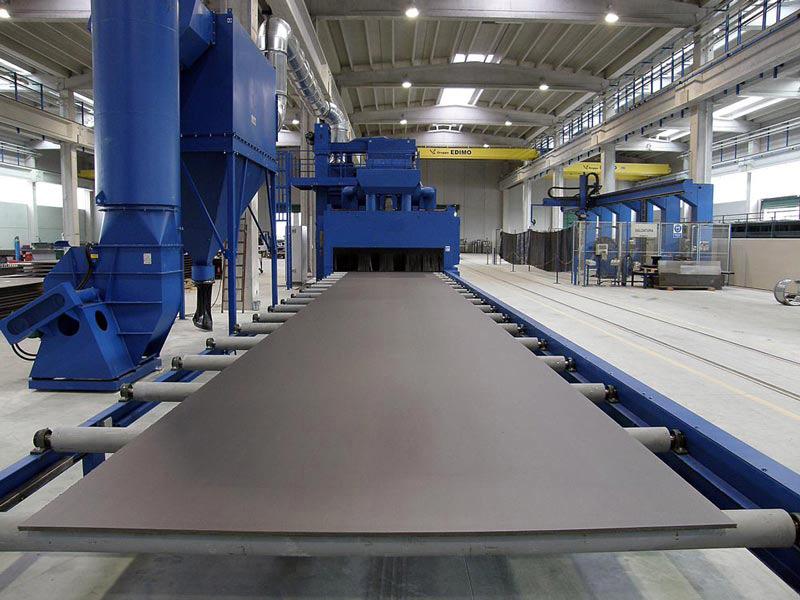
It relies on several high-power blast wheels mounted at precise angles above and below the plate. As the plate moves through on rollers, the wheels throw steel shot or grit at high velocity, while a recovery screw and elevator continuously clean and recycle the abrasive. The pass speed, wheel amperage and abrasive mix are tuned so the surface reaches the required cleanliness without warping the plate.
A properly set up machine can reach Sa 2.5 (near-white metal) or SSPC-SP10 and create an anchor profile of roughly 30 to 75 microns, depending on the abrasive size and hardness. Some operators also use grit mixtures to get a sharper profile for heavy-duty paint systems.
If the recovery system is weak, abrasive gets trapped in corners or carried out with dust, which raises running costs and hurts blasting consistency. A good factory designs the blast cabinet with proper air wash separation, magnetic or rotary screens, and correctly sized dust collectors so the abrasive stays clean and the working area stays safe.
It comes down to adjustable blast wheel power, variable roller speed, and a rigid but well-supported conveyor. Thin plates need lower wheel amperage and faster travel to avoid distortion, while thick plates can handle higher intensity and slower speeds. Factories that understand this will offer multiple presets or a PLC control with automatic recipes.
Don't only compare the purchase price. Check the expected life of wear parts like blast wheel blades, liners, and seals; the abrasive consumption per square meter; and the ease of replacing manganese liners or curtain rubbers. A slightly more expensive machine with better wear protection and faster part replacement often costs far less over five years.
Most standard plate machines are built for flat sheets and plates, but many factories can customize the tunnel height, add adjustable masking, or install a cross-transfer system for beams and profiles. If you need mixed production, ask for a demonstration with your own sample parts before finalizing the specification.
Conclusion
A serious shot blasting machine factory knows that removing mill scale and creating a blast profile are not the same job. One is about cleanliness, the other is about anchor depth and angularity. The abrasive mix ratio is where that difference lives: too much round shot and the surface stays smooth; too much angular grit and peaks tear too fast. Operators often miss this because the plate looks fine leaving the line. Inconsistent blast patterns rarely show up at first inspection. They appear months later as coating adhesion failures, uneven corrosion, or weld prep that never quite takes. That hidden delay is exactly why the best factories control abrasive size, hardness, and mix proportions line-side instead of trusting supplier defaults.
Adjustable turbine speed matters more on thick plate than on thin sheet. Heavier steel soaks up heat and resists deformation, but without speed control the abrasive either bounces off too shallow or digs in too deep, leaving a profile that varies across the width. Factory layout tells you whether the line was designed for flow or just assembled from standard components. A bottleneck at the pre-blast table or at the abrasive reclaim hopper shows up long before it hits the maintenance log. Dust collectors need to be matched to abrasive volume, not just air velocity. Too little suction and fines stay in the mix, altering surface finish; too much and usable abrasive gets pulled out of circulation. A factory that gets these details right rarely needs to explain why its machines produce consistent plates.
Contact Us
Contact Person: Bruce
Email: [email protected]
Tel/WhatsApp: +86 15166629468
Website: https://www.povalchina.com/