

Air Slip Ring Which One Is Truly Reliable
2026-08-28
When every rotation counts, the last thing you need is an air slip ring that fails mid-operation. But in a market flooded with lookalike products, identifying a truly reliable unit can feel like a shot in the dark. From leak-prone seals to inconsistent data transmission, hidden flaws surface only after installation—and by then, downtime has already begun. That’s where MOFLON enters the picture: a manufacturer that refuses to treat air slip rings as simple commodities. In this post, we strip away the marketing noise and focus on the engineering signals that separate dependable performance from premature failure. Whether you’re upgrading existing machinery or specifying for a new build, this guide will help you spot the difference before it costs you.
What Actually Breaks First in an Air Slip Ring
In most air slip rings, the pneumatic seals are the first components to show real trouble. They run against a rotating surface with only a thin film of compressed air or lubrication to keep them from tearing, so any grit, moisture, or oil carryover from the compressor eats away at the lip long before the electrical brushes give out. Once a seal starts to lose its edge, you get a slow pressure drop, a faint hiss, or uneven actuation well before a full failure shows up.
Electrical wear is usually slower but not always innocent. Brushes and contact rings can pit or glaze if the slip ring runs at high current or if the environment is dusty. However, the surprising early failure point is often the bearing set. Because an air slip ring carries both air lines and electrical circuits, any misalignment or side load from poorly supported hoses puts extra stress on the bearings. A worn bearing then lets the rotor wobble, which accelerates seal damage and makes the electrical contacts chatter.
The real first break, though, depends on how clean and dry the air supply is. Dirty air kills seals first. Dry or unlubricated air does the same by increasing friction at the seal lip. On the electrical side, moisture in the air can cause tracking and surface corrosion on the rings. If you ignore the early hiss or a slight increase in rotational drag, the next thing to go is usually the seal, followed quickly by the bearings once the leakage contaminates the bearing grease.
Seal Materials That Separate Long Life from Early Leaks
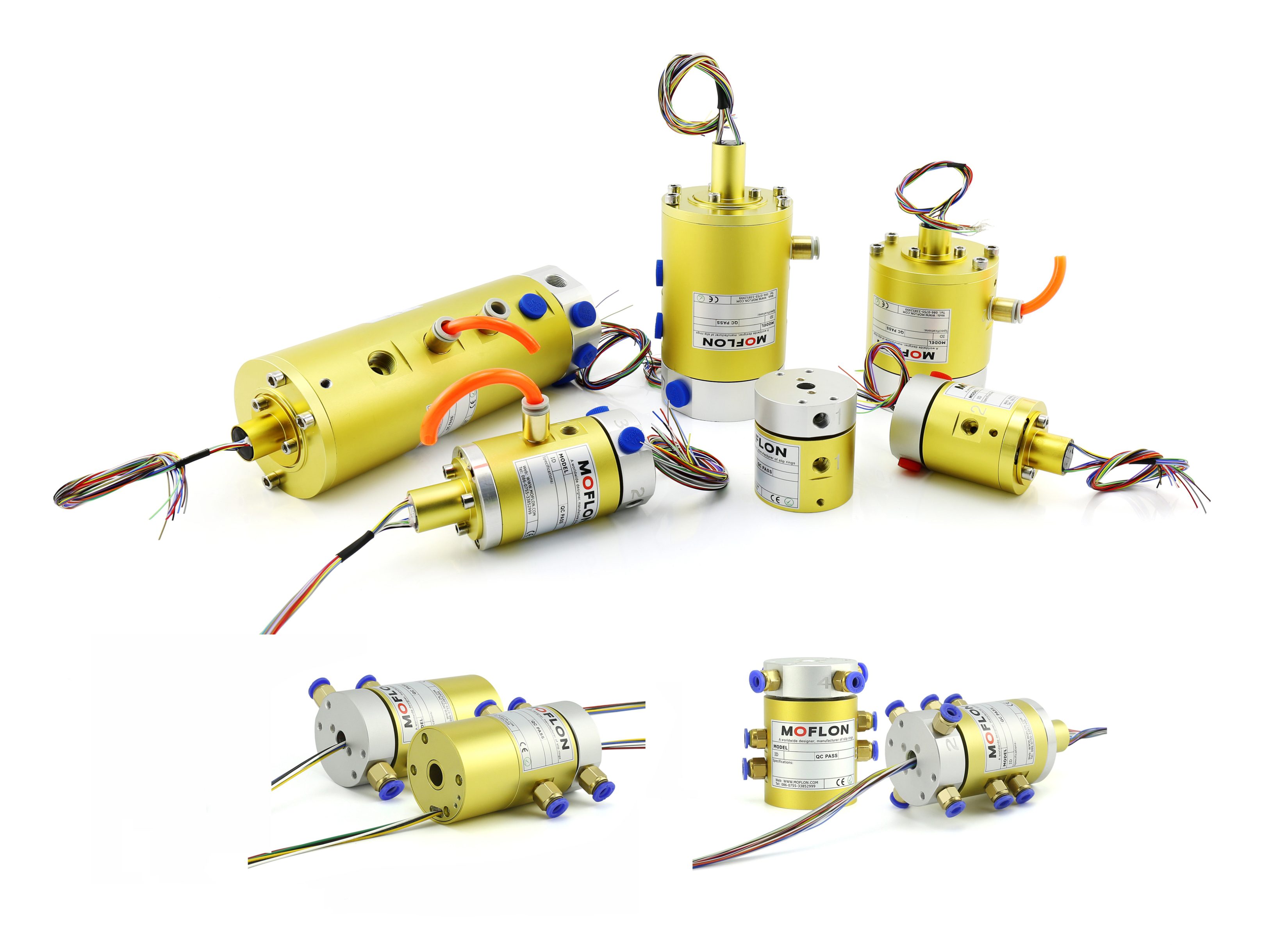
Early leaks rarely trace back to a material's published temperature range or chemical resistance chart. In dynamic seals, the real killer is often hysteresis heat build-up combined with micro-abrasion at the contact lip. A high-hardness FKM may look great on a datasheet for static service, yet when it is pushed into a reciprocating shaft application, its poor elastic recovery fails to follow the shaft's microscopic surface deviations. The resulting pumping effect drags a thin film of fluid past the seal on every stroke, eventually showing up as a visible leak that has nothing to do with chemical attack. Materials like a moderately filled HNBR or a modified PTFE compound often hold up far better simply because they balance low friction with enough resilience to maintain a dynamic contact line.
Static immersion tests create another blind spot. A lab coupon can show only 5% volume swell in a specific oil, so the material gets approved, but in a real gland with tight extrusion gaps that same swell closes the clearance and triggers rapid wear, or it shifts the stress distribution enough to cause localized over-compression. Long-lived seal materials tend to be those that stay dimensionally stable under load, not just in a beaker. Look for compounds that hold compression set below 15% at the actual operating temperature and keep hardness change within 5 Shore A after fluid aging. Equally important is friction stability: a compound that starts with a low coefficient of friction but develops stick-slip after a few thousand cycles will wear the mating surface and open a leak path far sooner than one with a slightly higher but steady friction profile.
The base polymer often gets too much credit. Two seals both labeled NBR can behave completely differently depending on the cure system and filler package. Peroxide-cured NBR with a fine, well-dispersed carbon black survives hot air and aggressive oil much longer than a sulfur-cured version with coarse filler. In the field, many early leaks are not catastrophic material failures but the slow creep of small changes: plasticizer migration hardening the lip, micro-cracks growing under ozone attack, or a batch-to-batch variation that lowered the crosslink density just enough to increase compression set. That is why a long-life seal is rarely an exotic fluoroelastomer. It is usually a common base polymer with unusually tight process control, such as a carboxylated nitrile with a high crosslink density that can outlast a standard NBR by a factor of three in oilfield service.
How Pressure Drop Exposes a Weak Design
In fluid systems, pressure drop is rarely the headline spec, but it’s often the first honest signal that something in the layout isn’t pulling its weight. A sharp elbow where a swept bend would do, a valve port that necks down a full size, or a filter housing with a tortuous inlet path can each shave off a few psi—and on a long enough run, those small penalties compound. Engineers who chase flow rate and ignore pressure drop eventually find that pumps work harder, temperatures climb, and energy bills quietly follow.
Weak designs tend to hide behind margins. A circuit might meet its target flow at full pump speed, yet the moment a filter begins to load or a heat exchanger fouls slightly, the pressure drop curve steepens past acceptable limits. That brittleness is the tell: if a modest change in viscosity or a partially closed valve sends the system from stable to cavitating, the original layout was never robust. The pressure gauge, in that sense, is less a monitoring tool than a confession.
Prototyping with pressure taps at key junctions doesn’t just spotlight which component is the bottleneck—it exposes how the designer thought about flow. A well-conceived path keeps velocities even, avoids sudden expansions, and treats every fitting as a cost. When the taps tell a different story, the numbers usually point to a geometry that was drawn for convenience, not for the fluid.
Bearing Choices You Cannot See on the Outside
While two bearings may share the same boundary dimensions, their internal geometry often tells a very different story. Raceway curvature, contact angle, and the precise amount of internal clearance or preload are engineered choices hidden behind the seals and shields. A deep-groove ball bearing optimized for high-speed spindle work, for instance, might run a lighter internal clearance and a carefully controlled raceway curvature to reduce heat generation—yet none of this is visible from the outside. These invisible parameters determine how load is distributed across the rolling elements and whether the bearing will hum quietly for years or fail early under edge stress.
Material selection and heat treatment add another layer of hidden differentiation. Through-hardened, case-carburized, or induction-hardened rings each bring distinct fatigue life and toughness characteristics, and the amount of retained austenite in the steel can shift under load, affecting dimensional stability. Surface finish on raceways and rolling elements, often specified in microinches, directly influences film formation and noise. Even the cage—whether stamped steel, machined brass, or molded polymer—is a quiet performer: its pocket clearance and guidance method can mean the difference between stable lubrication and cage skidding at high speeds.
Lubrication choices also hide in plain sight. The base oil viscosity, thickener type, and fill percentage are rarely printed on the bearing, yet they set the limits for speed, temperature, and relubrication intervals. Some bearings are specified with a particular grease for low-noise behavior, while others rely on oil-air delivery through internal channels that only show up in cutaway drawings. These invisible specs are what separate a commodity bearing from one that holds tolerance in a machine tool spindle or an electric motor running 24/7.
Real-World Runtime Data vs. Spec Sheet Promises
Manufacturers love to quote runtime figures that come from perfectly controlled lab conditions—ambient temperature fixed, screen brightness set to a dim 200 nits, and nothing but a local video loop playing. The moment you step outside with the sun glaring off the display, push the CPU with a few browser tabs and a chat app, and leave Bluetooth connected to earbuds, those promised hours evaporate. Real-world use is messy, and your battery drains in ways no spec sheet ever accounts for.
A laptop rated for 18 hours of "mixed usage" might limp to seven or eight once you enable background sync, run a video call, and keep the keyboard backlight on. The gap isn't always a sign of dishonesty—it's a mismatch between how the device was tested and how people actually live with it. You learn to multiply the official number by 0.6 and then subtract another hour for good measure if you plan to use Wi-Fi heavily.
What matters more than the headline figure is how the battery degrades over the first six months of daily charging. Some systems hold up surprisingly well, losing only a few percent of capacity, while others drop below 80% health before the warranty expires. If you want the truth about endurance, ignore the marketing slide and look for user-reported screen-on times from people who have already hammered the device through a full work week.
Questions to Ask Before You Trust a Supplier
Most supplier failures trace back to skipped questions, not dishonest answers. Before you hand over a deposit, ask about their production capacity in concrete numbers: how many units per week do they currently run, and what percentage of that is already committed? Then follow up with a specific request: send photos or a live video of the floor today, not last quarter's brochure shots.
The second question most buyers forget is about failure history. Instead of asking "have you ever had quality issues," ask "tell me about a shipment that went wrong and what you did the following week." A supplier who admits a past mistake and walks you through the corrective action is far safer than one who claims zero defects. Also ask who owns the factory versus who answers your emails; a trading agent can disappear faster than a factory owner with machinery and a lease.
Finally, tie trust to small tests before scaling. Ask if they will run a pre-production sample without a purchase order, and whether they will accept a third-party inspection you arrange and pay for. If they resist either, that hesitation tells you more than any certificate.
FAQ
It comes down to sealing design, material pairing, and how well the rotating union handles pressure drops. Look for hardened stainless steel rotors, PTFE-based seals, and a bearing arrangement that keeps runout minimal under load. Units tested for leak rates at maximum working pressure tend to outlast cheaper alternatives.
Ask for test reports that show leakage at your specific pressure, not just a datasheet number. Reputable suppliers will state the test gas, duration, and acceptable bubble count. If they only mention IP65 without context for rotating service, treat it as marketing rather than engineering data.
Integrated designs usually have fewer potential leak points because the air passages are machined into one body. Modular units are easier to service, but each junction adds a sealing interface. If you need minimal downtime and stable signal transfer, an integrated block with separate signal and pneumatic channels is often the better choice.
Bearings control concentricity between rotating and stationary sealing faces. Any wobble or radial play opens micro-gaps that cause gas leakage or premature seal wear. High-quality deep groove or angular contact bearings with proper preload will keep the seal faces aligned far longer than bushing-style supports.
Yes, but only if the seal profile is designed for bidirectional pressure or vacuum service. Standard O-ring grooves may extrude under vacuum or trap debris. Look for lip seals or U-cups that maintain contact in both pressure directions, and confirm the unit is rated for the lowest vacuum level you need.
With good filtration and dry air, a well-built rotary union may run 12 to 24 months between seal replacements. Maintenance intervals depend more on cycle speed, temperature, and air quality than on the basic design. Monitoring leak rate is the best indicator; schedule service when leakage exceeds the factory threshold rather than on a fixed calendar.
Watch for increased hissing at the joint, pressure drop above normal, torque rise during rotation, or moisture and oil carryover into signal lines. Any of these suggests seal face damage or misalignment. Catching these early usually prevents damage to the electrical slip ring section.
Premature failure often results from misapplication: wrong seal material for the gas type, excessive side load from rigid piping, or running at higher rpm than rated. Even a reliable design will fail if it is mounted with hose strain, vibration, or unfiltered air. Always check the manufacturer's allowable side load and mounting tolerance.
Conclusion
Most air slip rings that fail early do so for reasons that never appear on a cut sheet. The first component to break is rarely the conductive ring or the brush block; it is usually the seal surface. Once a seal wears unevenly or takes a thermal set, leakage begins and pressure drop climbs. A well-designed unit uses seal compounds matched to the actual air chemistry and temperature cycling, not generic nitrile or Viton chosen for cost. Pressure drop is a far better indicator of internal health than static leakage tests because it reflects how the air path, seal clearance, and rotor balance work together under load. If the pressure drop curve shifts within the first few hundred hours, the design has a weak internal geometry that no amount of external polishing can hide.
Bearings are the other hidden variable. A slip ring can look identical on the outside while using open, shielded, or preloaded bearings with different grease fills. That choice decides whether the unit runs quietly for five years or develops cage rattle and micro-fretting in six months. Real-world runtime data is the only honest way to compare units. Ask the supplier for failure records from installations that match your duty cycle—not accelerated lab tests. Request the exact seal material, bearing manufacturer and preload spec, and the pressure drop limit at your working flow. If the answers stay vague or point back to a glossy brochure, keep looking. A truly reliable air slip ring is built around transparent material choices and measured field data, not clever advertising.
Contact Us
Contact Person: Xiangpin Li
Email: [email protected]
Tel/WhatsApp: 86 186 1706 8578
Website: https://www.moflon.com