

7.3m Giant Fans Manufacturers: Engineering Massive Airflow Solutions for Industrial Applications
2026-06-20
When you think of industrial ventilation, the sheer scale of a 7.3-meter fan is almost impossible to picture—until you witness one in motion. These colossal air movers aren’t just oversized hardware; they’re precision-engineered systems that transform vast factory floors, warehouses, and hangars into breathable, efficient environments. But not all manufacturers approach this challenge the same way. At the forefront of this field, VINDUSFAN is redefining what it means to move massive volumes of air without compromise. What goes into designing a fan that can shift the atmosphere of a football-field-sized space? And how do you ensure reliability when the blades span longer than a bus? In this post, we’re pulling back the curtain on the engineering, innovation, and real-world performance that separate the truly exceptional from the ordinary.
How 7.3-meter blade spans redefine thermal comfort across vast factory floors
In sprawling factory halls, air temperature often stratifies with hot air trapped near the ceiling and cooler air settling at floor level, creating uncomfortable working conditions. A fan with a 7.3-meter blade span moves a massive column of air downward in a slow, steady push, displacing stagnant layers and mixing the entire volume without the harsh drafts of smaller, high-speed fans. This gentle circulation breaks up thermal pockets and delivers a uniform feel across the floor, so workers experience consistent cooling from one end of the building to the other.
The wide sweep of these blades means a single unit can cover an area up to 2,000 square meters, reducing the need for multiple smaller fans or costly ductwork. The air movement enhances natural evaporative cooling on the skin, lowering the perceived temperature by several degrees without actually conditioning the air. This makes the environment feel fresher and helps prevent heat-related fatigue, while also cutting energy costs compared to running air conditioning systems at full blast.
Beyond cooling, the slow rotation helps control condensation and moisture buildup by keeping surfaces dry, which is especially useful in industries where corrosion or product quality is a concern. Installation is straightforward, typically suspended from high ceilings, and the low-noise operation doesn’t interfere with communication or concentration. With minimal maintenance and a design that blends into the roof structure, these large-diameter fans quietly reshape how comfort is managed in large-scale industrial spaces.
Beyond brute force: The fluid dynamics driving these oversized air circulators
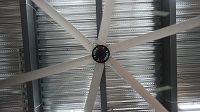
Big air circulators, often mistaken for brute-force blowers, actually rely on subtle fluid dynamics to move huge volumes of air efficiently. Instead of just ramping up fan power, designers tap into principles like vortex shedding and Coandă effect to direct airflow across large spaces without the energy penalty.
The key lies in how these fans manage boundary layers and induce entrainment—the process by which surrounding air gets pulled into the primary airstream. A well-designed blade profile creates a low-pressure zone that draws in adjacent air, multiplying the total airflow far beyond what the fan’s diameter alone would suggest. This entrainment can amplify output by 5 to 15 times, making a seemingly modest rotor remarkably effective.
Engineers also play with oscillation and flow separation to avoid dead zones and promote consistent mixing. By carefully tuning the fan’s speed and blade geometry, they ensure that turbulent eddies help distribute air evenly, preventing stagnation in corners and maintaining comfort without the blast effect. It’s a dance between laminar and turbulent flows, choreographed for maximum efficiency.
When standard ventilation fails: Heavy-duty cooling for foundries, hangars, and warehouses
Standard ventilation systems often buckle under the intense heat loads found in foundries, aircraft hangars, and sprawling warehouses. These aren’t your everyday spaces—molten metal radiates brutal temperatures, massive doors stay open for machinery, and sun-baked roofs turn interiors into ovens. When exhaust fans and basic airflow setups can’t keep up, the need for heavy-duty cooling becomes impossible to ignore. It’s not just about comfort; it’s about preserving equipment, protecting product integrity, and meeting safety thresholds that off-the-shelf solutions were never built to handle.
Heavy-duty cooling tackles these extremes with purpose-built design. Think high-volume, low-speed fans that span over 20 feet, moving a wall of air without the roar of high RPMs. Evaporative coolers step in where refrigerant-based units would choke on dust and heat, leveraging the natural cooling power of water evaporation to knock down temperatures by 20°F or more. In a foundry, spot cooling might target operator stations directly, while in a hangar, massive fabric duct systems distribute conditioned air evenly across vast, open bays. The common thread is brute-force capacity paired with surgical precision—cooling where it’s needed, not just everywhere.
What sets these solutions apart is how they’re engineered around the grit of the environment. Warehouses with high racking need airflow that penetrates dense storage without creating turbulent hotspots. Foundries demand equipment that shrugs off airborne particulates and corrosive fumes. Hangars require systems that don’t interfere with aircraft movement or maintenance operations. The best setups blend multiple techniques—perhaps destratification fans to reclaim heat in winter and adiabatic cooling pads for summer. It’s a far cry from plug-and-play ventilation, but when standard methods hit their limits, this is what keeps the wheels turning without meltdowns or missed deadlines.
The hidden engineering that keeps 500-pound fans gliding near-silently overhead
The gentle whoosh overhead goes almost unnoticed, yet suspending a 500-pound fan demands meticulous engineering. The secret starts with the motor design—direct-drive permanent magnet motors replace traditional gearboxes, eliminating the whine of meshing teeth. These motors run at low RPM with high torque, using precisely balanced rotors that counteract vibration. But it's the blade aerodynamics that truly silence these giants. Each blade is sculpted with winglet-like tips and swept profiles that slice air smoothly, disrupting the turbulent vortices that cause fluttering and hum. The materials—often a composite of carbon fiber and reinforced polymers—dampen resonance, absorbing energy that would otherwise ring through the structure.
Mounting systems play an equally subtle role. Instead of rigid brackets, custom-designed isolation mounts decouple the fan from the ceiling, attenuating structure-borne noise. These mounts use layers of elastomeric compounds tuned to specific frequency ranges, so the ceiling doesn't become a giant soundboard. Even the hub gets special treatment: it's precision-machined and dynamically balanced in multiple planes to within fractions of a gram, ensuring that the spinning mass creates almost zero net vibration. Thermal management is another hidden feat—integrated heat sinks and internal airflow channels keep motors cool without noisy cooling fans, relying on passive dissipation that never intrudes on the silence below.
From blueprint to breeze: Why bespoke mounting and controls matter more than motor specs
Anyone who has ever specced out a motor knows how easy it is to get lost in numbers—torque curves, RPM ranges, efficiency benchmarks. But here’s the quiet truth that veteran engineers learn: what separates a seamless installation from a constant maintenance headache isn’t the motor’s brochure. It’s the mounting system that holds it steady and the control logic that tells it when to breathe.
Off-the-shelf brackets and generic drives treat your application like it’s interchangeable with any other. They ignore the subtle vibrations of your floor, the way heat pools in your enclosure, or the distinct rhythm your process demands. Bespoke mounting doesn’t just bolt things down; it anticipates stress points, dampens resonance, and aligns every shaft perfectly before the first rotation. Paired with controls tuned to your exact start-up ramps, stop sequences, and load variations, the motor becomes an extension of your machine rather than a component that fights it.
When something eventually goes wrong—and it always does—custom solutions also save you from the blame game between manufacturers. No more finger-pointing over whether the drive triggered a fault or the bracket caused misalignment. You own the whole integration, and every piece was designed to work together from the very first sketch. That’s how you turn a blueprint into a breeze.
Materials that shrug off heat, humidity, and decades of continuous duty
Certain engineering materials seem almost indifferent to the punishing conditions that wreck ordinary components. High-nickel superalloys, for instance, maintain their strength at temperatures that would melt lesser metals, while fluoropolymers refuse to absorb moisture even after years in saturated air.
It’s not just about surviving a single challenge. In continuous-duty applications—think turbine blades spinning tens of thousands of hours or undersea connectors bathed in salt spray—the real marvel is the absence of cumulative damage. These materials don’t just resist; they simply wear out at a geological pace.
Behind this resilience is a mix of careful alloying and molecular architecture. Ceramic matrix composites dissipate heat so effectively that thermal fatigue becomes a non-issue. Polymers with densely cross-linked networks shed water molecules like a duck’s back. The common thread: design that ignores short-term fixes in favor of decades-long stability.
FAQ
They tackle uneven temperatures, stagnant air, and humidity pockets that smaller fans simply can't reach. By stirring the entire volume from a single point, they eliminate the need for ductwork and multiple smaller units, which cuts installation complexity and long-term energy use.
Floor fans blast air in narrow paths and create noise and trip hazards. A single 7.3m overhead fan gently pushes a colossal column of air downward and outward, covering up to 20,000 square feet with a non-disruptive breeze that feels like a 5-7°F cooling effect on skin.
They focus on hub-and-blade connection integrity, using aircraft-grade aluminum extrusions and redundant safety links. The gearboxes are thermally protected, and the mounting systems are custom-engineered to match roof structure load analysis. Vibration sensors and variable-speed drives come standard to prevent resonance issues.
Blade pitch is critical—too flat and the fan just spins without pushing air; too steep and the motor overworks. Leading makers use adjustable pitch hubs or computationally optimized fixed profiles that sustain laminar flow over the blade's length, delivering over 300,000 CFM while keeping power draw under 2 kW in some models.
Absolutely. By destratifying hot air that collects near warehouse ceilings, these fans can slash heating bills by up to 30% in the winter. In summer, they reduce or eliminate the runtime of chilled water systems, often paying for themselves within 18 months purely through utility offsets.
They need a partner who does on-site airflow modeling beforehand, not just a catalog vendor. The right manufacturer will review your building's structural drawings, offer installation supervision, and provide a 5- to 10-year warranty that covers both parts and labor on the motor and gearbox.
Quality manufacturers apply marine-grade coatings on blades and seal the motor against moisture ingress. In dusty environments, they recommend self-cleaning blade profiles and IP65-rated controls. When properly specced, a 7.3m fan can run 24/7 in a cement plant or a humid greenhouse with minimal deterioration.
Conclusion
Spanning 7.3 meters, these industrial fans don’t just move air—they reshape how entire factory floors experience thermal comfort. Instead of relying on raw power alone, manufacturers harness fluid dynamics to create gentle, far-reaching columns of air that displace stagnant heat without the turbulence of smaller high-speed units. When standard ventilation wheezes under the extreme loads of foundries, aircraft hangars, or warehouses, this engineered approach delivers heavy-duty cooling that keeps workers safe and processes stable. The blade profile and hub design work in concert to sweep air across spaces so vast that conventional methods leave pockets of dead air and stifling humidity untouched.
Yet what truly sets these machines apart is the hidden refinement beneath their sheer size. Every 500-pound fan rotates on bearings and motor systems tuned to near silence, suspended by mountings that absorb vibration before it reaches the building structure. Bespoke control logic, often overlooked, dictates start-up ramps and speed curves that matter far more than peak motor specs—ensuring year-round dependability without energy spikes. Underpinning it all are materials selected not just for strength but for decades of abuse: alloys and coatings that ignore heat, shrug off condensation, and resist the slow creep of fatigue. The result is a piece of industrial infrastructure that, once installed, glides overhead almost forgotten, while quietly making a massive footprint of air breathable and workdays bearable.
Contact Us
Contact Person: Michael Danielsson
Email: [email protected]
Tel/WhatsApp: +1 951 565 7769
Website: https://www.vindusfans.com